
Home Theater Cost in Frisco: 2026 Complete Pricing Guide
No obligation · We aim to respond within one business day
Complimentary phone consultation
Talk it through with a local designer. Written proposal before anyone books a crew.
No obligation · We aim to respond within one business day
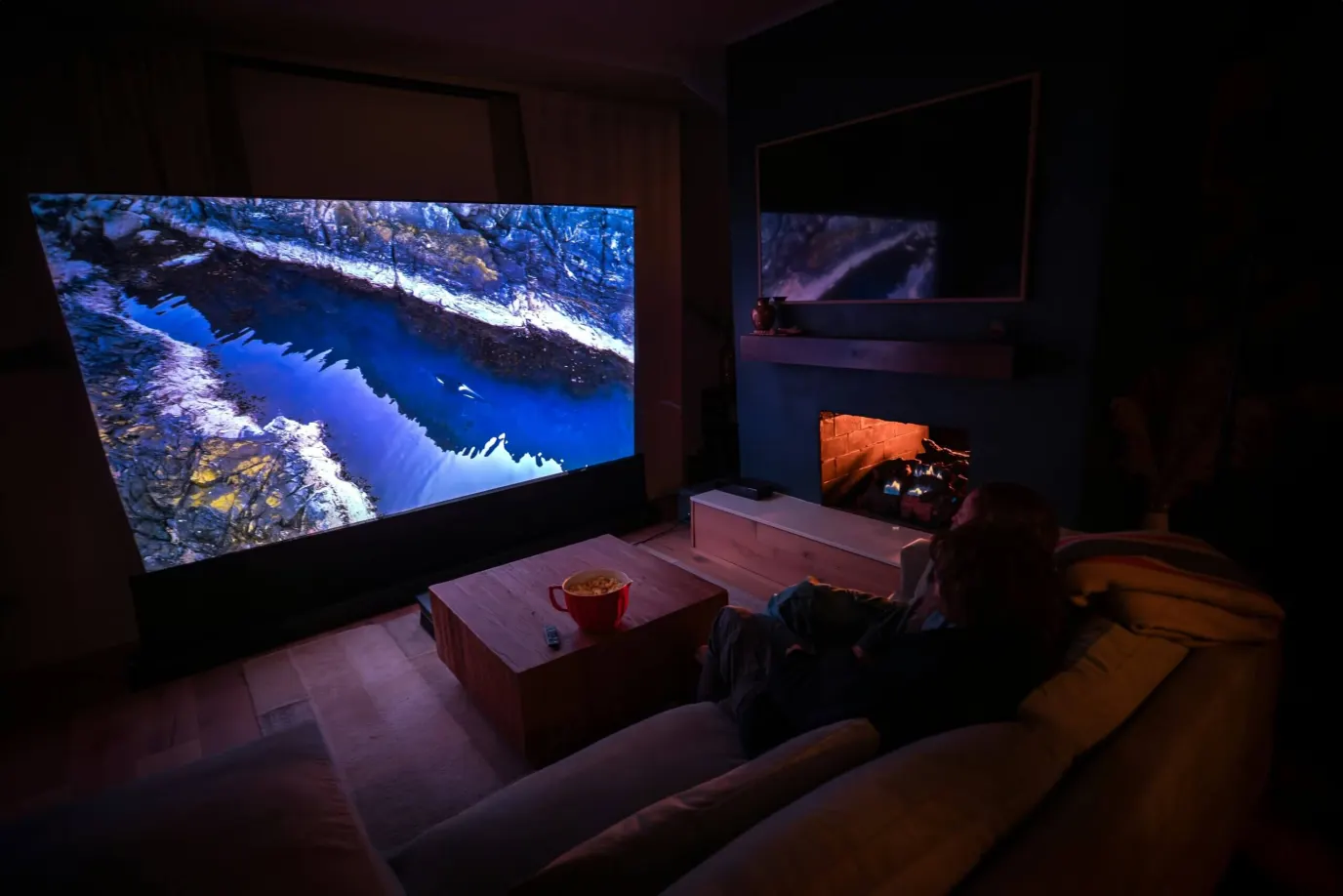
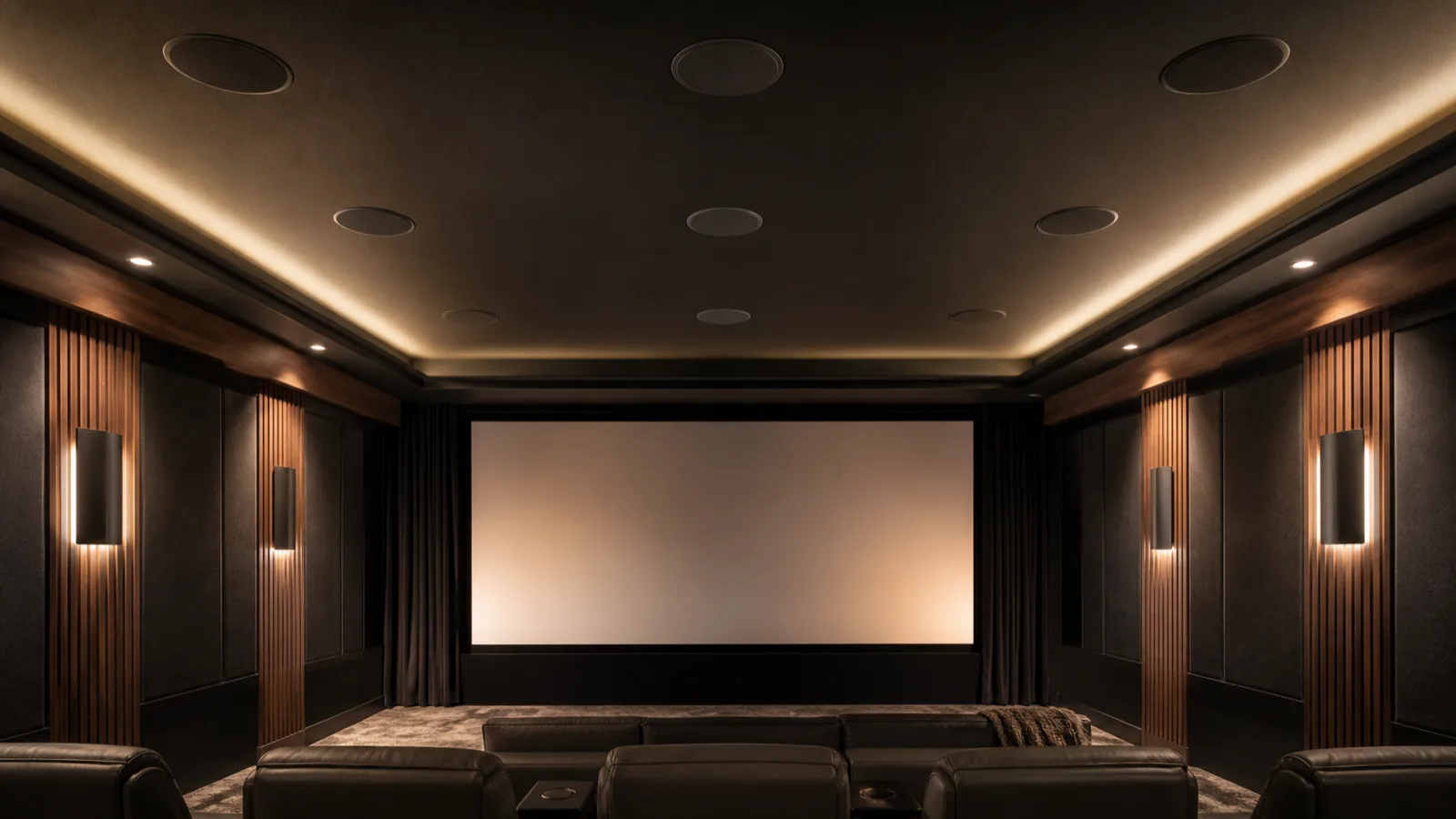
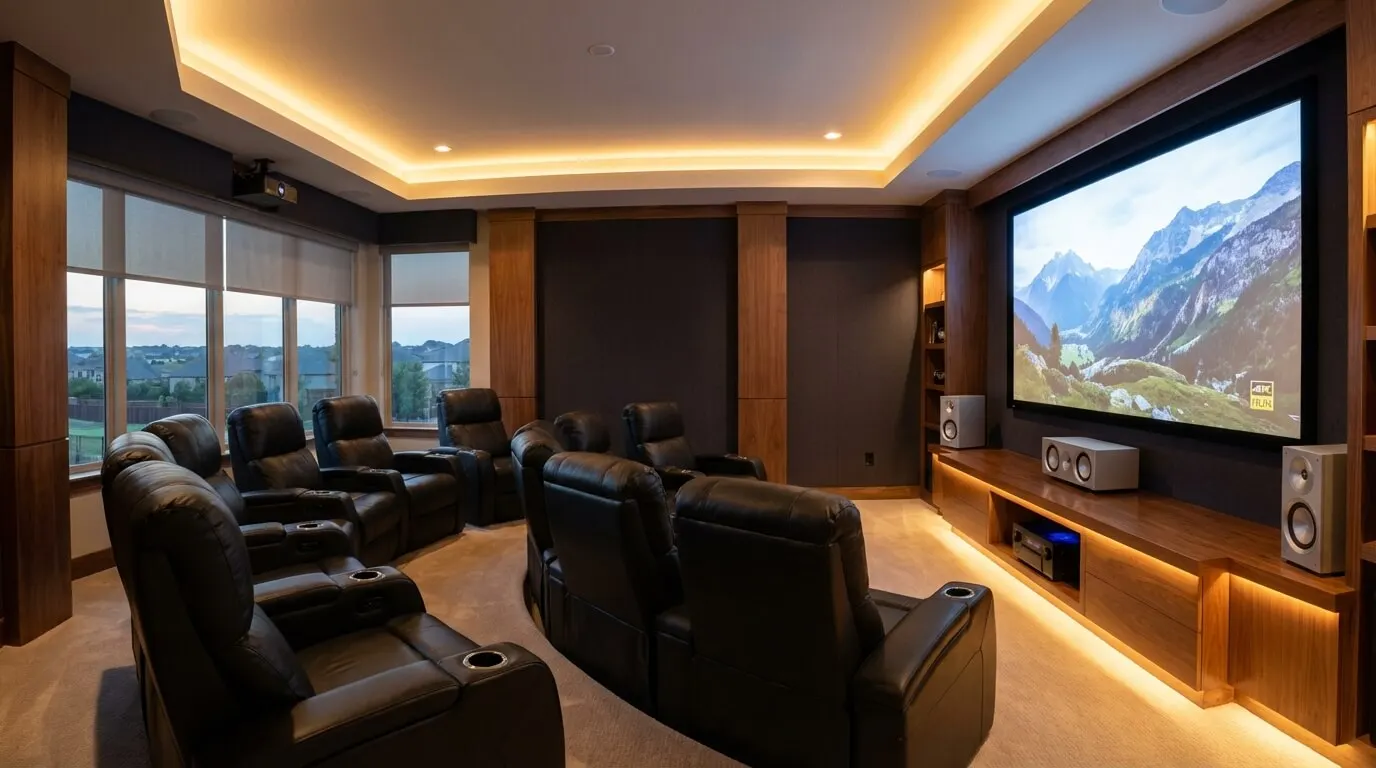
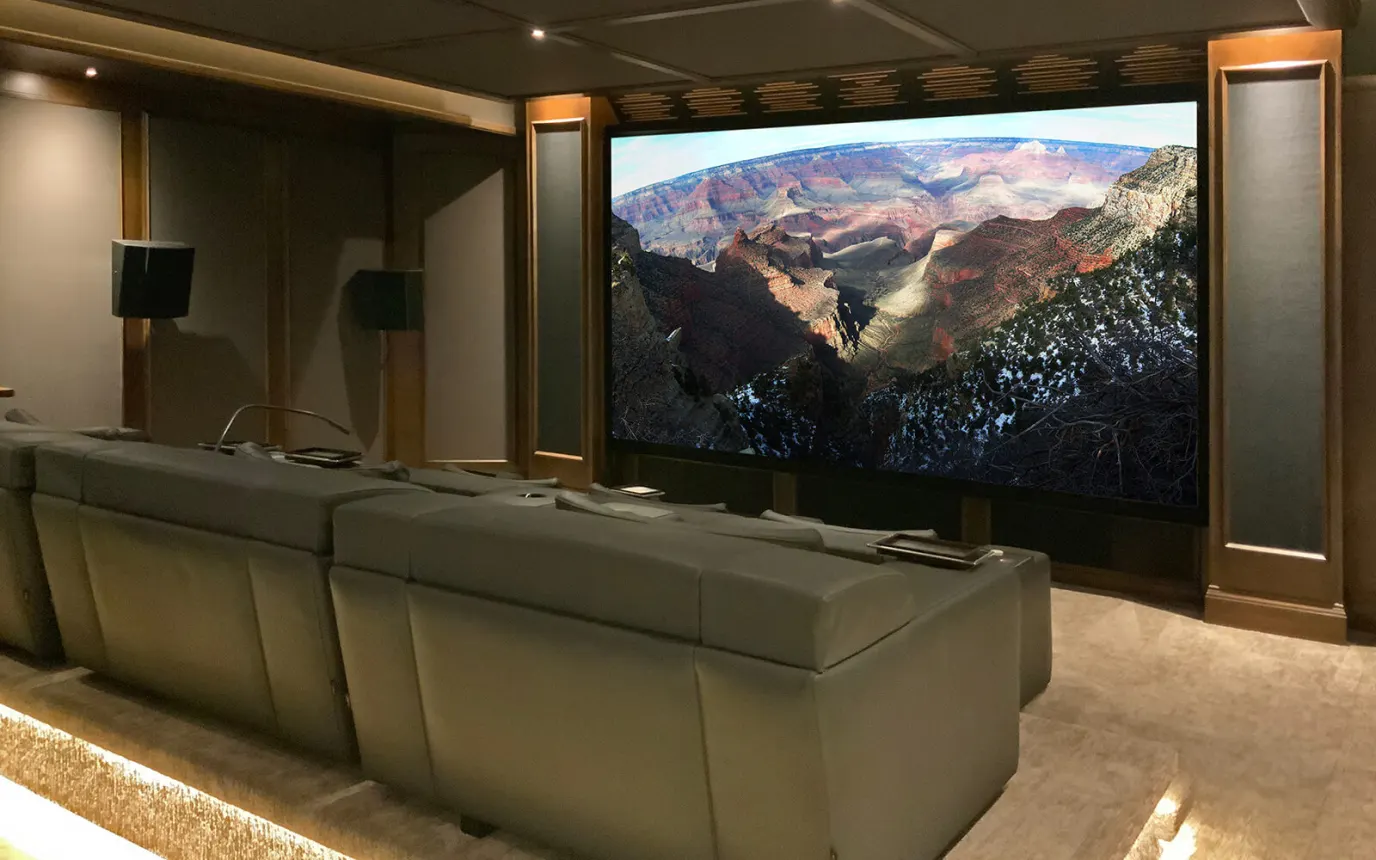
A home theater in Frisco can mean a family-room upgrade or a room built around movies. Budgets in the room table below run from $15,000-$25,000 for a basic media room to $100,000-$300,000+ for a dedicated luxury cinema. Ranges are for planning; your written proposal follows a site visit. Display choice, speaker layout, wall access, seating and building work determine what the proposal needs to include.
How much should you budget for a Frisco home theater?Link to this section
Start by deciding whether the room must still work as a living room. Keep the sofa and daylight if that is how you use it. Choose a dedicated theater when you want control over light and sound and can give the room to that purpose. Buying more expensive equipment does not settle that decision.
At Digitalholics, we measure the space and the light before pricing, so the budget matches one of three jobs: a dedicated cinema, a media-room conversion, or a retrofit around the architecture you already have.
For equipment choices once you have a budget band in mind, see the Frisco home theater systems guide. Before pricing a display, use the screen size tool to convert your seating distance into a diagonal, since display size is one of the biggest drivers of the equipment cost below. That tool describes a flat image from the seat; it does not pick a projector or its throw distance.
What do people mean by home theater units in Frisco?Link to this section
Two different questions share that phrase. Some readers mean seats: the seating table on this page prices individual seats and shows a four-seat total so you can multiply by your actual seat count. Those four-seat totals are $2,000-$3,200 for basic recliners, $6,000-$10,000 for powered theater seats, and $12,000-$24,000 for premium cinema seats. Others mean installers: to compare them, request separate equipment, labor, electrical and seating lines in each written proposal.
| Room Type | Size Range | Budget Range | Timeline | Best For |
|---|---|---|---|---|
| Basic Media Room | 12’×14′ | $15,000-$25,000 | 1 week | Multi-purpose family rooms |
| Quality Media Room | 14’×16′ | $25,000-$45,000 | 1-2 weeks | Serious movie watching |
| Premium Theater | 15’×18′ | $50,000-$85,000 | 2-3 weeks | Home cinema enthusiasts |
| Luxury Cinema | 18’×22’+ | $100,000-$300,000+ | 3-6 weeks | Dedicated luxury room |
Use the room table above as the planning reference. Ask what each proposal includes, especially construction, electrical work and seating.
A Frisco planning band is not a Dallas quote. A Dallas house has its own room dimensions, light, and wall access, so it needs its own measurement rather than this page's bands applied directly.
A boxed receiver-and-speaker bundle is a different purchase from a complete installed room. Compare the equipment list separately from mounting, wiring, programming, room treatment and building work. A boxed system can be a sensible DIY purchase if you can follow its instructions and keep the work to accessible plug-in connections.
Complimentary phone consultation
Planning a theater or media room?
Tell us the room and how you like to watch. A complimentary phone consultation is the first step — no obligation, and the written proposal is yours to keep.
No obligation · We aim to respond within one business day
Which equipment costs belong in the same comparison?Link to this section
Equipment-only budgets run $8,000-$15,000 for entry equipment, $15,000-$35,000 for mid-tier equipment and $40,000-$100,000+ for reference equipment. Those labels do not establish sound quality. Require exact model numbers and a reason for each upgrade.
Display and screenLink to this section
Choose a TV if you plan to leave the room bright and want a familiar daily setup. Consider projection if you will control the light and want a larger image. Before buying either, mark the image boundary on the wall and sit where you will actually watch. The projector versus TV comparison handles that choice in detail.
| Display Type | Size Range | Cost Range | Best For |
|---|---|---|---|
| Entry 4K Projector | 100-120″ | $2,000-$4,000 | Budget media rooms |
| Quality 4K Projector | 110-133″ | $4,000-$8,000 | Dedicated theaters |
| Premium 4K Laser | 120-150″ | $8,000-$25,000 | Reference quality |
| 85″ QLED TV | 85″ | $2,500-$5,000 | Bright media rooms |
| 98″ Premium TV | 98″ | $8,000-$15,000 | Luxury media spaces |
The brand-class rows below are budget labels, not model specifications, availability checks or manufacturer price quotations. Use the projector cost guide for the projector-specific scope.
| Brand/Model Class | Resolution | Cost Range | Best For |
|---|---|---|---|
| Epson Home Cinema | 4K | $2,000-$4,000 | Budget-conscious builds |
| Epson Pro Cinema | 4K HDR | $4,000-$8,000 | Mid-tier quality |
| Sony VW Series | 4K HDR | $5,000-$15,000 | Premium performance |
| JVC NZ Series | Check the model sheet | $8,000-$25,000 | Reference quality |
| Sony/JVC Laser | 4K laser | $15,000-$50,000 | Higher equipment allowance |
Other display options: higher-resolution projectors $25,000-$50,000+; OLED TV $3,500-$6,000; MicroLED $50,000+. Screens run $800-$2,500 fixed-frame, $2,000-$5,000 acoustically transparent (sound passes through the screen), and $5,000-$15,000 motorized with masking (movable borders around the image). Inspect any proposed projector-and-screen pairing in the light you will watch in.
Audio and controlsLink to this section
Surround systems run $3,000-$8,000 basic, $15,000-$35,000 premium and $35,000-$75,000+ reference, with $8,000-$15,000 for an Atmos upgrade. Price the speaker layout as its own line rather than folding it into a complete-room figure.
| Equipment check | Manufacturer value | What to ask before buying |
|---|---|---|
| Denon AVR-X3800H | Nine channels of amplification | Name the amplifier channel that will power each speaker. |
| Dolby 7.1.4 overhead layout | Seven listener-level speakers, one subwoofer, four overhead speakers | Count the speaker channels separately from the subwoofer; check amplification for the proposed layout. |
| Dolby 5.1.2 overhead layout | Five listener-level speakers, one subwoofer, two overhead speakers | Confirm whether the proposal prices the smaller 5.1.2 step or the larger 7.1.4 layout. |
| Ultra High Speed HDMI cable | Up to 48Gbps (gigabits per second); supports 4K@120 formats | Specify the cable type and test the installed source-to-display path. |
Dolby Atmos adds sound from above the seats. A 5.1.2 layout is the smaller Atmos step below 7.1.4. A 7.2.4 layout is the two-subwoofer step above 7.1.4: the same seven listener-level speakers and four overhead speakers, with two subwoofers instead of one. A subwoofer handles deep bass. A receiver combines source switching, audio processing and amplification. The table exposes a purchasing trap: a layout name does not tell you how many speakers a receiver can power. Ask for the connection plan before approving the equipment order. More speakers are not worth paying for when they cannot be placed usefully; the Atmos layout guide covers placement.
Ask what the installer measures before handover. Our THX-certified technicians measure speaker levels and timing in the finished room with calibrated microphones. Ask how picture color will be checked as part of the final setup.
Components: entry receivers run $800-$1,500; mid-tier receivers at $1,500-$3,500; premium processors at $4,000-$8,000; reference processors at $12,000-$30,000. Speakers run $200-$600, $400-$1,200, $600-$2,000, $800-$2,500 and $2,000-$5,000 per speaker across ascending budget categories. Subwoofers run $400-$800, $1,200-$2,500 and $3,000-$8,000+.
Control runs $300-$500 for a universal remote, $2,000-$5,000 for a processor-based system, $8,000-$20,000 for integrated control and $15,000-$40,000 for broader automation. Keep ordinary remotes if they already do the job. Pay for programmed control when it makes the equipment easier for your household to use.
What changes the cost to build the room around the equipment?Link to this section
Ask for acoustic treatment and sound isolation as separate lines. Treatment addresses the sound you hear inside; isolation addresses sound passing into adjoining spaces. Identify the complaint first: unclear dialogue at the sofa calls for a different discussion from bass heard in a bedroom. The Frisco room acoustics guide explains those choices.
Treatment budgets read $3,000-$6,000, $6,000-$12,000 and $12,000-$20,000+ for progressively larger jobs. Have the installer list panel locations and the problem each treatment addresses.
Test seating before ordering it. Check recline clearance, passage to the door and whether everyone can see past the seats ahead. Keep existing furniture if it meets those needs. Seating figures follow; the total column is an example using four seats.
| Seating Type | Cost per Seat | Total (4 seats) | Features |
|---|---|---|---|
| Basic Recliners | $500-$800 | $2,000-$3,200 | Manual recline, cup holders |
| Powered Theater Seats | $1,500-$2,500 | $6,000-$10,000 | Power recline, USB charging, LED lighting |
| Premium Cinema Seats | $3,000-$6,000 | $12,000-$24,000 | Leather and tray tables |
Example: seat total = seat count × unit allowance. Four basic recliners at $500-$800 each give $2,000-$3,200. Apply that same multiplication to the actual quantity; do not add the total column to the per-seat column.
Finishes: carpet runs $1,500-$5,000; wall finishes at $2,000-$8,000; lighting at $1,000-$5,000; concession area at $3,000-$15,000; decorative elements at $1,000-$5,000. A separate furniture-and-decor line runs $2,000-$15,000, including tables $200-$800, concession equipment $1,000-$5,000, artwork $500-$3,000, accents $500-$2,000 and storage $800-$3,000. Mark overlapping work before adding these figures.
What installation and electrical work can change the quote?Link to this section
Before you approve installation work, ask who owns the cable path, wall repairs, electrical work and final setup. Photograph the attic access and walls before asking for a price. A cable route that looks short on a floor plan may need a different path once the installer sees the structure. If the walls are still open, run speaker cable and confirm the screen-wall framing before drywall closes; every wire added after paint means cutting and patching.
Labor budgets read $5,000-$10,000 basic, $10,000-$18,000 standard and $18,000-$35,000+ complex. Ask what each band includes before stacking labor onto an installed package that may already cover it.
Frisco offers residential permit routes for minor electrical projects and for additions or alterations. Have the electrician and city identify the route for your actual scope. Ask whether the proposed loads require a service upgrade at all. Before pricing panel work, ask an electrician to calculate the proposed household load and confirm the permit requirements with Frisco.
Electrical budgets read $1,500-$8,000 overall: $1,500-$2,500 basic, $2,500-$4,000 standard and $4,000-$8,000 complex. The permit line was $150-$300 and electrician labor was $90-$130/hour; confirm both with the city and the electrician for your scope.
Heating and cooling runs $2,000-$12,000 overall, with a thermostat zone at $800-$1,500, ductwork at $1,200-$3,000, mini-split at $3,500-$7,000 or separate system at $8,000-$12,000. Ask the mechanical contractor about equipment heat, occupants and fan noise before choosing an option.
Structural and isolation work runs $3,000-$20,000 overall: doors $1,500-$3,500, window changes $500-$2,000, wall insulation and damping $2,000-$8,000, resilient channels $3,000-$8,000 and floating floors $5,000-$15,000. These construction methods need a design; do not buy them as automatic upgrades.
The contingency examples added $10,000-$15,000 to a $50,000 theater or $15,000-$25,000 to a $100,000 theater. Replace that blanket reserve with priced exclusions before signing. If the room sits in a business instead of a home, price the technology separately from the building work; the budgets above cannot price a commercial building. The commercial AV service page covers the technology portion of a business fit-out.
How should you compare borrowing options?Link to this section
Compare total repayment and fees, not just the monthly payment. Get the room scope settled first, then request written lender terms for that amount. Check the annual percentage rate, whether the rate can change, the repayment term, fees and early repayment conditions.
A home equity line of credit, or HELOC, lets you borrow against your home equity. Rates are usually variable, and failure to repay can put your home at risk. Compare that risk with a personal-loan offer. For credit cards, cash-out refinancing or builder financing, ask the lender to show the full cost and collateral terms. Confirm any installer payment arrangement directly; do not assume financing comes with the installation.
Postpone decorative work or keep the existing display if borrowing makes the room uncomfortable to afford. Spending examples of $20,000, $50,000+ and $200,000 describe different budgets, not reasons to borrow more.
What will upkeep cost, and should you count on resale value?Link to this section
Budget for the equipment you actually choose. Ask who pays for troubleshooting, replacement parts and later programming changes. Keep subscriptions separate from hardware service so you can see what continues even when the room needs no work.
Upkeep: $300-$600 per lamp replacement, $200-$500 per recalibration, $0-$200/year for cleaning and $30-$80/month for streaming. Maintenance bands run $200-$800 annually. Price upkeep from the equipment you actually choose and the subscriptions you actually keep, rather than a single blended figure.
Do not count on a resale recovery to justify the room. Buy it for the use you can afford.
Does a home theater increase home value?Link to this section
Ask an appraiser how a built-in theater might affect the valuation of your particular house. Budget for the room you and your household will actually use, using the upkeep bands above, rather than counting on a specific resale recovery.
What should you prepare before hiring an installer?Link to this section
Send the same room information to each bidder. A useful proposal should let you remove a feature and understand what cost changes, without losing an essential part of the system.
- Sketch doors, windows, seating and the screen wall. Photograph the room in the light in which you watch.
- List equipment you want to keep, with model numbers and the devices you plug into it.
- Identify the cable route and access limits. Assign wall repair, paint, electrical and cooling work to a named contractor.
- Ask for equipment, installation, treatment, seating and control as separate lines. Flag costs already included in a package.
- Agree on completion checks: dialogue from each seat, picture with normal room lighting, source switching and a household member using the remote.
- Get exclusions, payment stages, service terms and the installation schedule in writing before ordering.
Use the contact page to request a complimentary phone consultation with Digitalholics.
What happens after you callLink to this section
Describe the room, how you watch, and the equipment you want to keep. If the project is a fit, we book a walkthrough and measure the space and light before preparing a written, line-item proposal. You approve the scope before anyone books a crew. Ask for equipment, installation, treatment, seating, and control as separate lines, and agree on completion checks before ordering.
Bring your room plan to the home theater service page for the next step.
SourcesLink to this section
Complimentary phone consultation
Want this room costed properly?
Bring the room type, size, and the screen and sound you want. A complimentary phone consultation turns that into a written line-item proposal — no obligation.
No obligation · We aim to respond within one business day