
Motorized Shades and Blinds: Benefits for Frisco Homes
No obligation · We aim to respond within one business day
Complimentary phone consultation
Talk it through with a local designer. Written proposal before anyone books a crew.
No obligation · We aim to respond within one business day
Motorized shades are worth it on glass you cannot reach, on west rooms that overheat before the thermostat catches up, and in bedrooms that need blackout on a schedule. Battery motors skip wall work in a finished house. Hardwired low-voltage motors belong on new construction and on high openings. A north window you can pull by hand can stay manual.
The rest of this page is the decision, not a catalog. Cost lives on the Frisco motorized-shade cost guide. Lighting keypads live on the Lutron lighting page. What follows is power, fabric, safety, wiring, and when to leave the window alone.
When are motorized shades actually worth it?Link to this section
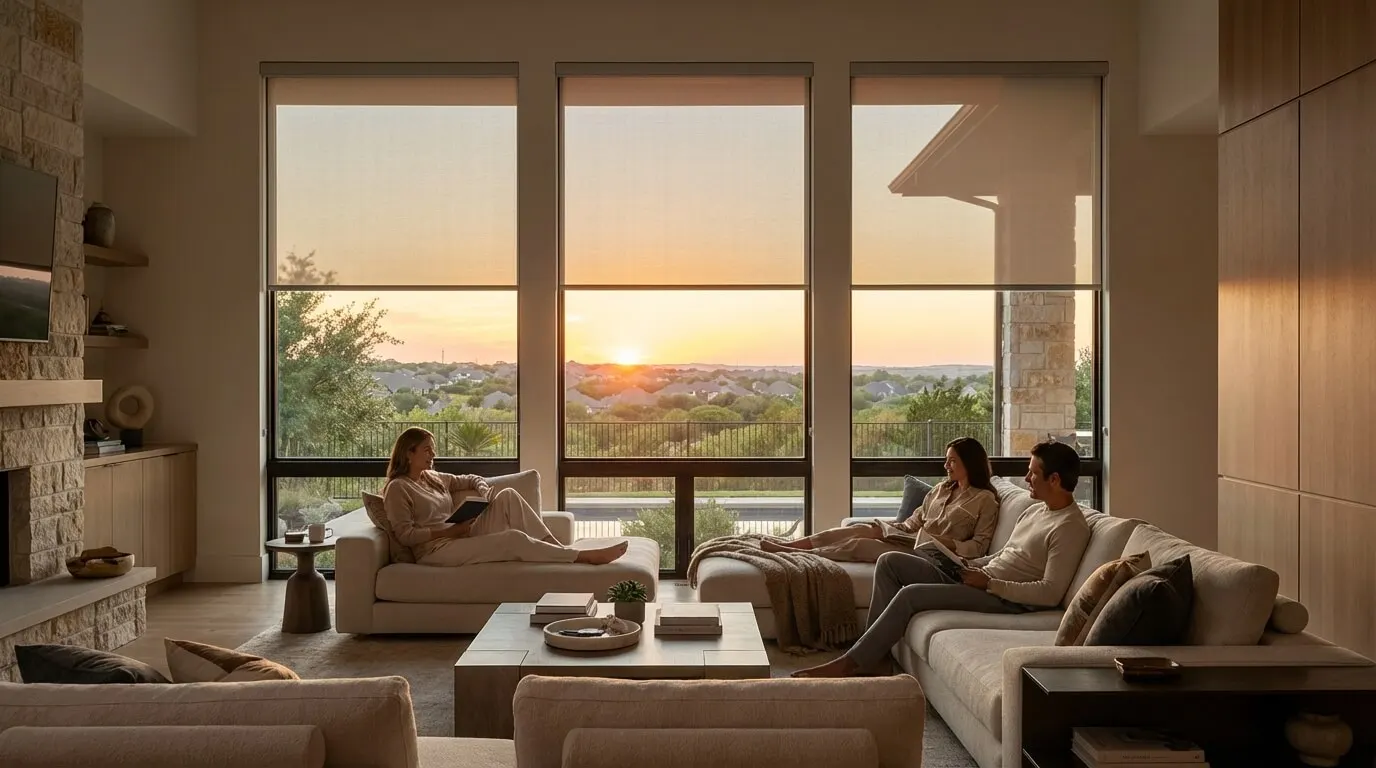
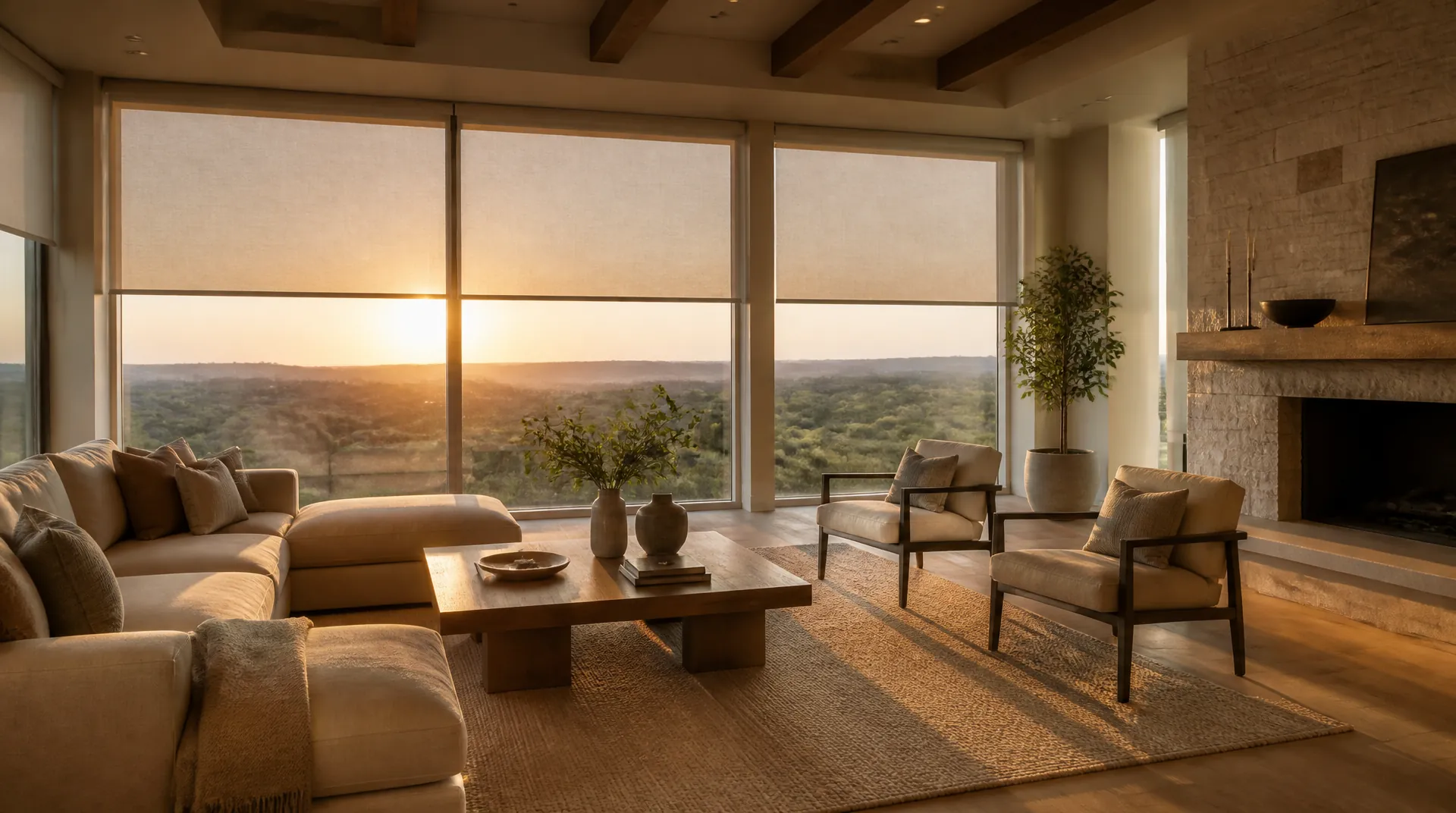
Buy them for a job a wand cannot do well. A two-story stair wall is the obvious case. So is a west family room that is unusable at 4 p.m. Dallas/Fort Worth's 1991-2020 climate normals include an average of 20 days at 100 degrees each year. That is a lot of afternoon glass. A shade on a time-of-day or sun-position schedule drops the fabric before the room loads up with heat. A thermostat chasing that load is late.
The other honest case is sleep and screens. Blackout fabric, or a blackout layer on a dual roller, is for bedrooms, nurseries, and media rooms. A solar screen is for glare and view. Mixing those jobs on one fabric usually fails one of them.
Skip motorization when the window is small, easy to reach, and faces north. A hand pull still works. Motorizing every opening in a house because the first one felt nice is how a project bloats without solving a new problem.
A typical scenario: a two-story west living room with a wall of glass, a TV that washes out after lunch, and a stair landing nobody wants to climb twice a day. That room is a candidate. The powder room under the stairs is not.
Complimentary phone consultation
Curious what lighting, shades, or whole-home control would feel like in your house?
Describe the rooms and the routines you want. A complimentary phone consultation is the first step — no obligation.
No obligation · We aim to respond within one business day
Battery, hardwired, or PoE: which power should you pick?Link to this section
Pick power per opening, not per house. People ask about three power options, and they are not interchangeable. The company's roller-shade page says Clear Connect is engineered for 3-5 years of battery life on wire-free shades. Its Serena Open Roll spec lists 2 year battery performance typical using five D-cell alkaline batteries. Those two figures do not match. Treat them as estimates, not a promise.
Lutron Application Note 561 (Revision F, October 2024) is the useful document. It says battery-life estimates assume two cycles (two full up and down motions) per day. Move the shade more often, add a lot of wireless sensors on the same radio channel, or run sun-tracking that adds extra motions, and the calendar life shortens. The note also says D-cell shades should use alkaline cells, not lithium, carbon-zinc, or rechargeable D-cells.
Hardwired is a different product. The Sivoia QS Roller 64 spec lists operating voltage as Class 2, 35 V from a Lutron NEC Class 2 supply. QS wired systems can carry power and communication in a single 4-wire cable. QS Wireless systems take low-voltage power on a 2-wire cable. Noise is specified as not exceeding 35 dBA measured 3 ft from the drive. Shades on that line are supposed to stay aligned within 1/8 in (3 mm). Standard Roller 64 widths run from 17.5 in up to 8 ft; the WIDR (Lutron's wide-opening version) goes to 12 ft. The broader Sivoia line lists custom widths from 20 in to 20 ft. Those ranges are not one SKU. Size the drive to the cloth.
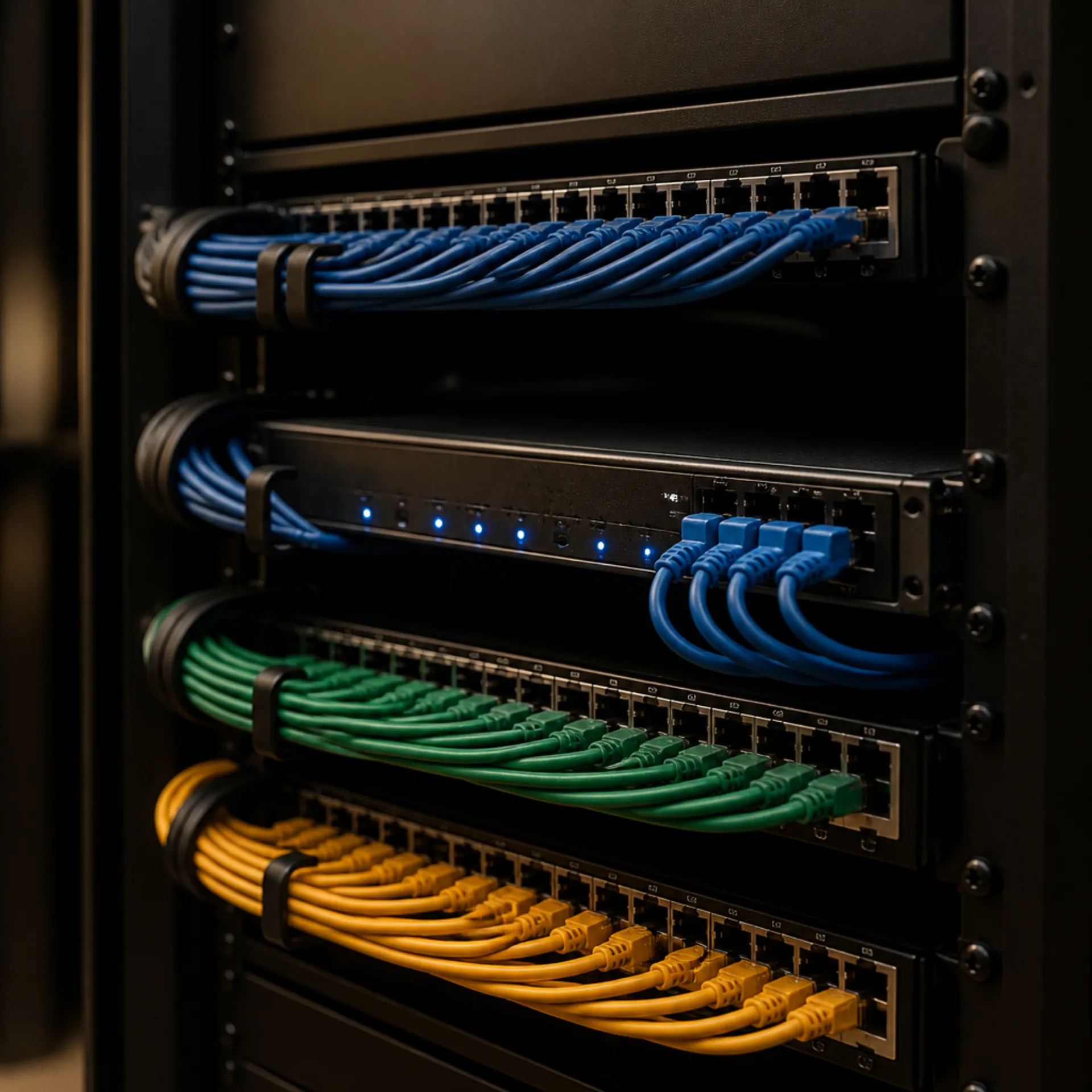
PoE is the option people ask about after they have seen a network switch in a rack. It is not how Lutron powers the shade motor on the spec sheets above. The Athena small-area hub spec allows a separate IEEE 802.3af-2003 or 802.3at-2009 PoE supply for compatible gateways, on Cat5e with a 328 ft (100 m) Ethernet segment. That is hub power, not a Serena battery sleeve. IEEE 802.3bt Type 4, often called PoE++, is listed by the Ethernet Alliance at 90 W at the switch (PSE) and 71.3 W at the powered device. Do not buy a Type 4 switch expecting it to run a D-cell shade.
| Power | What the manufacturer states | Wiring at the window | Choose this if | Skip this if |
|---|---|---|---|---|
| Battery (wire-free) | Serena Open Roll spec: 2 year typical, five D-cell alkaline. Roller-shade page: 3-5 years for Clear Connect wire-free. App note: estimates assume 2 cycles/day. | None. Bracket to the existing trim. | The room is finished, the opening is reachable, and you accept battery changes. | The shade sits over a stair void, or you plan heavy sun-tracking motion. |
| Hardwired Sivoia QS | Class 2, 35 V. QS wired: 4-wire power plus communication. QS Wireless: 2-wire power. | Low-voltage run to the headrail. Pocket on new work. | New construction, high glass, or daily motion you do not want on batteries. | You cannot pull low-voltage and will not open a finished wall. |
| PoE (control network, not the Serena motor) | Athena hubs/gateways: 802.3af or 802.3at on Cat5e, 328 ft max segment. 802.3bt Type 4: 90 W PSE / 71.3 W PD. | Ethernet to the hub or gateway, then Lutron's own shade power to the opening. | The processor already sits on a PoE switch. | You thought PoE++ would replace the motor's power supply. |
DIY is fine on a reachable Serena battery shade when you can follow the bracket template and you do not need a whole wall to line up. It is a poor plan on two-story glass, on a hardwired Sivoia run, or when several shades on one elevation have to stop at the same hembar (the bottom bar of the shade) height. Alignment is the part people notice from the sofa.
Which fabric openness should you specify?Link to this section
Motorized blinds give you another way to manage daylight: tilt the slats while leaving the blind down. Adjust the angle through the day to balance the view with light coming into the room. Lutron's Sivoia range includes wood blinds and horizontal sheer blinds, alongside motorized roller shades. A roller gives the window a clean fabric face; your fabric choice decides how much light passes through it. Both can be motorized. Choose blinds if adjusting slat angle is the control you want throughout the day. Choose a roller if you prefer a flat fabric panel and want to compare screen, privacy, or blackout cloth. Ask to see both move before choosing.
Openness is the percentage of the weave that is holes. Lower numbers block more view and more UV. Color still matters: a dark 3 percent screen cuts glare harder than a white 3 percent screen, because the yarn absorbs more light. Phifer SheerWeave publishes the set most people mean when they say 1 / 3 / 5 / 10 percent. Style 2500 is about 1% open, 2410 about 3%, 2390 about 5%, 2360 about 10%. The same page lists UV blockage of about 99%, 97%, 95%, and 90% in that order.
Visible light through the cloth is not the same as openness. On Phifer's V21 Charcoal, visible transmittance (Tv) is 2 at 1 percent, 3 at 3 percent, 6 at 5 percent, and 12 at 10 percent. White yarns in the same styles transmit more. Hold samples on the glass at the ugly hour. A phone photo of a swatch is a weak substitute.
| Openness | Phifer style | Approx. UV blockage | Tv on V21 Charcoal | Use it when |
|---|---|---|---|---|
| 1% | 2500 | 99% | 2 | You want privacy and a dimmer view. Street-facing glass, first floor at night. |
| 3% | 2410 | 97% | 3 | Most living rooms: keep the view, cut the glare. The default west-glass pick. |
| 5% | 2390 | 95% | 6 | You care more about daylight than a crisp TV. East kitchens, breakfast rooms. |
| 10% | 2360 | 90% | 12 | You want the most view of this set and will accept more glare. |
Blackout is a different product. Lutron describes sheer, privacy, and blackout fabrics on the Sivoia page, and pile-lined side channels when you need the edges dark too. Dual rollers put a screen and a blackout on one opening so the living room can keep the view at noon and go dark at movie time. One layer cannot do both well.
A solar screen is a summer-glare tool. If winter heat loss is the job, ask about cellular honeycomb shades instead of a solar screen. Do not shop a 3 percent screen expecting it to behave like a honeycomb cell.
Are motorized shades safer around children?Link to this section
A motorized shade with no operating cord removes the loop a child can put a head through. That is the point. 16 CFR Part 1260 is the federal safety standard for operating cords on custom window coverings. It took effect May 30, 2023. The rule incorporates ANSI/WCMA A100.1-2018. CPSC's findings in that part state that an accessible operating cord longer than 8 inches can let a child wrap the cord around the neck or insert a head into a loop, and that the hazard covers children 8 years old and younger.
Cordless motors meet the spirit of that rule by design. A tensioned continuous-loop clutch on an old manual shade does not. If a house still has corded stock from before the current rules, replacing those openings, especially over cribs and beds, is the safety project. Motorization is one way to get there. A cordless manual clutch is another, and it is cheaper if you can reach the hembar.
Do not treat a motor as a babysitter. Furniture still gets pushed under a window. The rule exists because supervision does not catch a silent entanglement in time.
Retrofit or new construction: what wiring do you need?Link to this section
On a finished house, battery brackets mount to the trim or the ceiling. No drywall opening. That is the retrofit default. Confirm battery-sleeve clearance before you order. The Serena Open Roll spec shows a slide-out sleeve and extra depth in front of the shade so the pack can come out. Tight inside-mounts with no front clearance force you to drop the whole shade to change cells. That is miserable on a header you need a ladder to reach.
On a new build, plan the pocket or fascia (a cover that hides the roller) before framing. Power is a low-voltage run to each opening, not a line-voltage receptacle in the header unless the specified motor actually needs mains. Sivoia QS as specified above is Class 2 at 35 V. The electrician who "just dropped a plug in the pocket" has not read the sheet. Coordinate the pocket size with the tube diameter. A Roller 64 pocket is sized to that drive, not to a larger tube.
If the house is mid-construction and the walls are still open, pull the shade cable now even if you will live on batteries for a year. Retrofitting low-voltage later means fishing through finished gypsum. Builders will close that wall whether you are ready or not.
Lutron's Application Note 561 says to order Triathlon shades with "Plug-in" or "Panel" power supplies; they cannot be field-converted from battery to wired power. As a general installation option, ask your installer about a plug-in supply behind a valance. That needs a suitable receptacle and access to the supply. Confirm the location before the shade ships.
What are the honest downsides?Link to this section
They cost more than a wand. That discussion belongs on the cost page, not here. The operating downsides are the ones that surprise people after install.
Batteries die on a schedule you will forget. High windows need a lift or a long wait for a service visit. Radio traffic from occupancy sensors on the same channel can wake a battery shade all day; Lutron's application note is blunt about that. Sun-tracking adds motions. If you want the shade to chase the sun across a west wall in July, do not put that opening on D-cells.
Hardwired motors need a plan. Miss the rough-in and you are fishing cable or living with a surface raceway. Power supplies occupy rack or closet space. A failed supply takes down a group of shades at once.
Fabric still fades, just more slowly. A 3 percent charcoal screen cuts UV; it does not stop it. Hardwood and art next to west glass still need the shade down during the brutal hours, which is why the schedule exists.
Alignment takes commissioning. Out of the box, a wall of rollers can look like a city skyline. Limits get set, hembars get matched, and those positions get stored. If you DIY a whole elevation, budget time for that or live with the skyline.
Integration is optional. A handheld remote on one shade is enough for a guest room. A keypad scene that drops shades and dims the room is a lighting-system job. Digitalholics is a Lutron Gold Dealer, so shades and lights can share a button when you ask for one-button scenes. It is not required to enjoy a battery roller in a bedroom.
Room by room: motorize it or leave it?Link to this section
| Room | Motorize? | Power | Fabric starting point |
|---|---|---|---|
| West living or dining, tall glass | Yes. Heat and glare are the reason most people call. | Hardwired if the header is high; battery if you can reach it. | 3 percent dark screen. Dual roller if you also watch movies here. |
| Primary bedroom | Yes if you want blackout on a clock. No if you already pull a good manual blackout every night. | Battery is fine on a reachable header. | Blackout, or dual roller if you want a daytime view. |
| Nursery or kids' room | Yes when the existing shade still has an operating cord. Cordless is the safety requirement, motorized or not. | Battery, unless the window is over a crib and you never want a ladder in that room. Then hardwire. | Blackout. Keep furniture off the sill. |
| Stair void / two-story glass | Yes. This is the "cannot reach it" case. | Hardwired. Battery changes on a lift get skipped. | 3 percent screen, maybe 1 percent if the stair faces a neighbor. |
| East kitchen | Maybe. Morning glare for a short window of the day. | Battery. | 5 percent if you want the room brighter; 3 percent if the sink faces the sunrise. |
| North study with a view | Often no. Easy reach, little heat gain. | Manual clutch, cordless. | Whatever you like looking at. Motorize later if you hate the pull. |
| Patio door you use all day | Yes if you want it to close when you leave, or if the door is too wide for a pleasant pull. | Hardwired on new work; battery on a retrofit slider if the shade is not huge. | Screen for daytime; add drapery if you need night privacy. Lutron lists motorized drapery on the Sivoia page. |
Choose battery if the opening is reachable, the house is finished, and daily motion is a couple of full cycles. Choose hardwired Sivoia QS if the opening is high, the walls are open, or the shade will move with the sun all afternoon. Leave it manual if you can pull it, the room is not a heat problem, and nobody in the house is at risk from an old cord.
What should you check before anyone measures?Link to this section
Use this before you hire an integrator, a shade shop, or a handyman. It also works if you are doing one Serena battery shade yourself.
- Stand in the room at the hour it fails. Note compass direction, which seats get glare, and whether the TV or a crib sits on that wall.
- Count openings on that elevation. One ugly window is a different job than eight that have to line up.
- Measure approximate width and drop, including inside-mount depth. You are not ordering from this number. You are catching the opening that is wider than the drive you had in mind, or too shallow for an inside mount.
- Decide screen, blackout, or dual roller per room, not per house.
- Decide battery or hardwired per opening. If the answer is "I will not climb that," it is hardwired or it is a skip.
- On new construction, ask the builder whether shade pockets are in the ceiling plan and whether low-voltage is pulled to each header. If the answer is a shrug, stop the drywall.
- If children use the room, specify cordless. Check that existing loops are gone, not just tied to a cleat.
- If you want one button for lights and shades, say so now. That is a Lutron system conversation, not a fabric conversation. Start on the Lutron dealer page only after the openings and power are clear.
- Have fabric samples held on the glass in that light. Approve color from the window, not from a website tile.
Schedules that close west glass before the heat arrives pair well with a thermostat that is not fighting the sun. The smart thermostat energy guide and the smart-home comfort guide cover those pieces.
If you want a per-opening measure and a written line-item proposal, the motorized shades service page is the next step. Work starts with a complimentary phone consultation from the Plano office. Reach the team through the contact page when you have the room, the hour, and the opening count in hand.
SourcesLink to this section
- Lutron, Custom Motorized Roller Shades
- Lutron, Serena Open Roll Shades specification
- Lutron, Application Note 561, Optimizing Battery Life in Lutron Shades
- Lutron, Sivoia QS Wireless Roller 64 specification
- Lutron, Sivoia motorized shades, blinds, and drapery
- Lutron, Athena Small Area Hub specification
- Phifer, SheerWeave Style 2500, 2410, 2390, and 2360
- eCFR, 16 CFR Part 1260, Safety Standard for Operating Cords on Custom Window Coverings
- NWS Fort Worth/Dallas, 1991-2020 climate normals
- Ethernet Alliance, Overview of 802.3bt
Complimentary phone consultation
Ready to see how it would work in your home?
Start with a complimentary phone consultation. We map the rooms, the scenes you would actually use, and what integrates with what — then a written, line-item proposal before anything is scheduled.
No obligation · We aim to respond within one business day