
Motorized Shades Cost in Frisco: 2026 Complete Pricing Guide
No obligation · We aim to respond within one business day
Complimentary phone consultation
Talk it through with a local designer. Written proposal before anyone books a crew.
No obligation · We aim to respond within one business day
Motorized shades in a Frisco house usually land between $400 and $1,500 per window installed, and a whole-house job is often planned between $10,000 and $50,000. Window count, fabric, motor power, and the control system move that number. For 20-30 windows, plan the whole house around $18,000-$35,000. Ranges are for planning; your written proposal follows a room measurement.
You can add motors to existing window coverings in a finished Frisco house, or specify new motorized fabric. Battery motors skip most wall work. Hardwired motors belong on new construction and on glass you would rather not climb to service. Installation scope lives on the motorized shades service page. This page is the budget.
What moves the price on a Frisco house?Link to this section
Five things set the bill: how many openings you cover, which rooms you start with, whether each motor is battery or hardwired, the fabric and hardware tier, and how far you take the programming. A west living-room wall is a different job from a powder-room window you can reach by hand.
We measure every opening individually; nothing is ordered from a plan dimension. A tape on the glass beats a floor-plan width. Out-of-square drywall, a shallow jamb, or a missing pocket changes the bracket, the fabric cut, and the labor line.
Start with the openings that fail first. In North Texas that is usually west glass in the late afternoon, then south glass through midday. Dallas/Fort Worth's 1991-2020 climate normals include an average of 20 days at 100 degrees each year. A shade that drops before that load hits the glass is doing a different job than a north-hall roller.
Programming is its own line. A phone app and a few schedules are cheap. Tying shades to lighting keypads and climate, plus a leaving-home scene, takes more commissioning time. If lighting is in the same project, read the lighting control cost guide so those two scopes are not quoted twice.
Complimentary phone consultation
Curious what lighting, shades, or whole-home control would feel like in your house?
Describe the rooms and the routines you want. A complimentary phone consultation is the first step — no obligation.
No obligation · We aim to respond within one business day
What do shades cost by shade type and brand?Link to this section
The per-window bands below are installed bands, not a cart total from a manufacturer site.
| Shade type | Band per window | Where it earns the cost |
|---|---|---|
| Roller shades | $400-$900 | Clean face, modern rooms, easy pairing with a solar screen or blackout cloth |
| Cellular / honeycomb | $500-$1,200 | Air pockets in the fabric; the energy case in the Department of Energy fact sheet below |
| Solar shades | $400-$800 | Living areas where you want the view and less glare |
| Roman shades | $700-$1,500 | Folded fabric face; more cloth and more hardware than a roller |
| Sheer / dual shades | $600-$1,300 | Bedrooms that need a view layer and a dark layer on one opening |
| Drapery on a motorized track | $800-$2,000 | Wide glass and a lined drape; the track is a separate product from a roller tube |
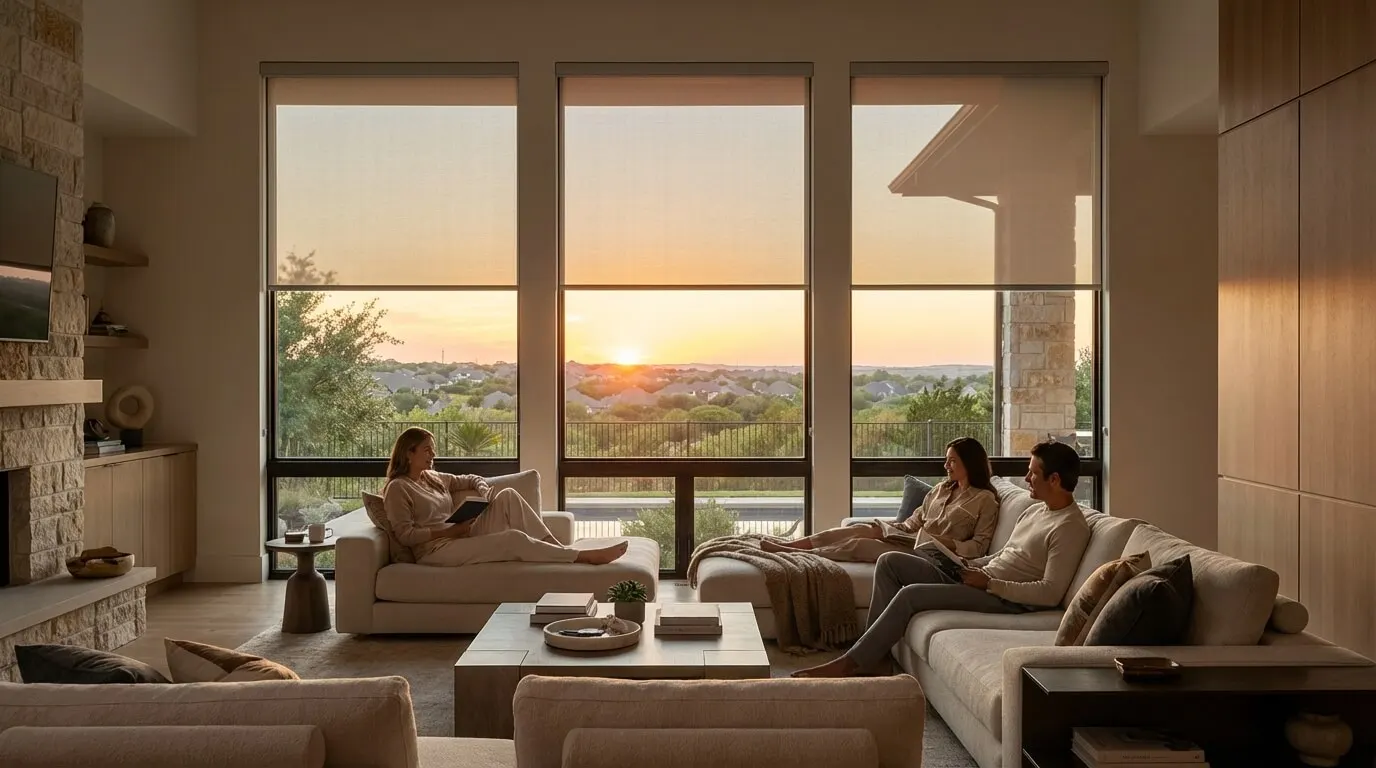
We choose fabric openness, color, and liner against the room's finishes, with samples held up in the actual light rather than picked from a screen. Openness is the weave's hole percentage. A dark solar screen cuts glare harder than a white screen of the same weave, because the yarn absorbs more light. Dual rollers put a screen and a blackout on one opening when the room has to do both jobs. Comfort and glare, plus privacy, are covered in the motorized shades and blinds guide.
| Brand / line | Band per window | What that line is for |
|---|---|---|
| Lutron Serena | $600-$1,200 | App, remote, and a hub, with optional voice, on a consumer shade; DIY or pro install |
| Hunter Douglas PowerView | $700-$1,500 | Schedules, app, Pebble remote, and a gateway for other smart-home systems |
| Somfy | $500-$1,100 | Wire-free motors on many shade styles, including wide drapery |
| Coulisse | $450-$900 | Lowest price range in this table |
Lutron Serena is sold as a shade plus a smart remote plus a Lutron smart hub. The hub page on that site says the hub controls up to 75 Lutron smart devices and works with Alexa, Google Assistant, and Siri. Hunter Douglas PowerView adds schedules, a Pebble remote, and a Gateway for other manufacturers' systems. Somfy WireFree is a battery motor family for roller, roman, and cellular shades, plus drapery, with phone control through myLink.
Window width still moves the same shade type:
- Small windows (under 36 in wide): $400-$700
- Standard windows (36-60 in): $500-$1,000
- Large windows (60-96 in): $900-$1,500
- Extra large (96-144 in): $1,500-$2,500
Volume bands, per window, run $700-$1,200 for 1-5 openings, $600-$1,000 for 6-12, $500-$900 for 13-20, $450-$800 for 21-30, and $400-$750 for 31 or more. Those are planning steps, not a discount a dealer will honor without a count.
Battery or hardwired: which openings are worth each?Link to this section
Pick power per opening, not per house. The two installed bands are $400-$900 for battery-powered motors and $600-$1,200 for hardwired motors, plus $100-200 per window when electrical work is required for a hardwired run.
| Power | Band | What the manufacturer states | Choose this if | Skip this if |
|---|---|---|---|---|
| Battery / wire-free | $400-$900 | Serena Open Roll spec: 2 year battery performance typical on five D-cell alkaline cells. The Serena and Sivoia QS Triathlon roller spec lists 3-5 year battery life on a 3 ft by 5 ft light-filtering shade moved twice a day. Those two figures do not match; treat them as that model's estimates. Somfy WireFree: rechargeable lithium-ion, once or twice a year, or a solar panel. | The room is finished, the opening is reachable, and you will change or charge cells. | The shade sits over a stair void, or you want daily sun-tracking motion on a battery pack. |
| Hardwired | $600-$1,200, plus $100-200 electrical | Sivoia QS Roller 64 ships as QS Wired or QS Wireless; wired systems can take low-voltage power on a 4-wire cable. Hardwired Sivoia-class drives are a different product from a D-cell Serena sleeve. | New construction, a planned pocket, or glass you do not want to service on a ladder. | You cannot pull low-voltage and will not open a finished wall. |
Battery-replacement bands run $15-30 per shade. That is a cell or charge cost, not a motor replacement. The Serena spec says battery life varies with shade size, fabric weight, and daily use, and it wants alkaline D-cells, not mixed types.
On a new Frisco build, the cheaper time to run shade power is before drywall. The new-home pre-wiring guide is the place to put that on the builder's list. A finished house can still take battery motors bracketed to the trim that is already there.
The Sivoia QS Roller 64 spec lists a WIDR option up to 12 ft wide, and a standard Roller 64 up to 8 ft. The Serena Open Roll spec is narrower: widths 24.5 in to 108 in. Size the drive to the cloth. A 144-inch opening in the extra-large band above is not a Serena Open Roll.
How should you budget a few rooms versus the whole house?Link to this section
House-size bands are below. Monthly energy dollars in this table are savings allowances, not a utility bill.
| House size | Window count | Band | Monthly energy allowance | Payback band |
|---|---|---|---|---|
| Small (2,000-2,500 sq ft) | 12-18 | $10,000-$18,000 | $40-$80 | 10-15 years |
| Medium (2,500-3,500 sq ft) | 18-25 | $18,000-$30,000 | $60-$120 | 8-12 years |
| Large (3,500-5,000 sq ft) | 25-35 | $28,000-$45,000 | $90-$150 | 7-10 years |
| Estate (5,000+ sq ft) | 35-60+ | $45,000-$80,000+ | $120-$250+ | 6-8 years |
Rule of thumb: payback years = project allowance ÷ (monthly savings × 12). Example: the small-home low allowance of $10,000 at the high monthly $80 is $10,000 ÷ ($80 × 12) = 10.4 years, which sits at the short end of that row's 10-15 year band. The same $10,000 at $40 per month is $10,000 ÷ ($40 × 12) = 20.8 years, which is longer than that band. Use the formula on your own allowance and a real summer bill, not the short end of the table.
Three house packages are below. Each total is the sum of its own lines.
Essential coverage: $10,000-$18,000Link to this section
A 15-window first pass, usually west glass, a primary bedroom, and a few south openings.
- 8 west-facing windows, blackout cellular: $6,400
- 4 primary-bedroom windows, dual shades: $4,000
- 3 south-facing windows, solar screen: $1,800
- Wi-Fi bridge / hub: $300
- Measurement, install, programming: $2,200
- Training and scene setup: $400
- Total: $15,100 (sum of the six lines above)
Annual energy allowance on this package: $500-$800.
Complete main-floor and bedroom coverage: $20,000-$35,000Link to this section
A 25-window pass with a control-system line.
- 12 high-impact windows, blackout cellular: $10,800
- 8 living-area windows, solar screen: $5,600
- 5 secondary bedrooms, light-filtering roller: $3,000
- Control4 shade integration: $2,500
- Measurement, install, programming: $4,500
- Scenes, schedules, sun tracking: $1,000
- Total: $27,400 (sum of the six lines above)
Annual energy allowance on this package: $900-$1,400.
Premium whole-home: $35,000-$55,000Link to this section
A 30-45 window pass, including oversized glass and specialty shapes.
- 25 primary windows, blackout cellular: $22,500
- 3 oversized motorized drapery: $6,000
- 4 arched or angled custom openings: $6,000
- 10 secondary rollers: $5,000
- Control4 or Savant integration: $3,500
- Installation and programming: $9,000
- Total: $52,000 (sum of the six lines above).
Annual energy allowance on this package: $1,200-$2,000.
Labor is broken out separately. The labor total is installation plus programming on each row.
| Window count | Installation labor | Programming / training | Labor total (sum of the two columns) |
|---|---|---|---|
| 5-10 windows | $800-$1,500 | $200-$400 | $1,000-$1,900 |
| 11-20 windows | $1,800-$3,500 | $400-$600 | $2,200-$4,100 |
| 21-35 windows | $3,500-$6,000 | $600-$1,000 | $4,100-$7,000 |
Adders: $100-200 per window for high ceilings (12-16 ft), $200-600 for specialty shapes, and $100-200 per window for hardwired electrical work.
Example: 15 openings at the roller band of $400-$900 is $6,000-$13,500 in shades. Add the Essential hub $300, install $2,200, and training $400 and the range is $8,900-$16,400. That band overlaps Essential coverage $10,000-$18,000.
Before you call anyone, walk the house with this list:
- Count openings by facing: west, south, east, north.
- Mark which ones you cannot reach without a tall ladder.
- Write battery or hardwired next to each opening, and why.
- Assign each room a job: view, glare, blackout, or both (dual).
- Photograph the trim, the jamb depth, and any existing pocket.
- Note the control system you already have, or none.
- Circle the rooms that can wait for a later phase.
What does app, voice, or whole-home control add?Link to this section
A shade that only moves from a wand is a different product from a shade on a scene. Control bands:
| Control level | Band | What you are paying for |
|---|---|---|
| Basic app control | $100-$300 | A hub or bridge and simple schedules |
| Voice (Alexa / Google) | $200-$500 | The same hub plus voice-assistant setup |
| Control4 integration | $1,500-$4,000 | Shades in the same scenes as lighting and climate |
| Savant integration | $2,500-$6,000 | The same idea on a Savant controller |
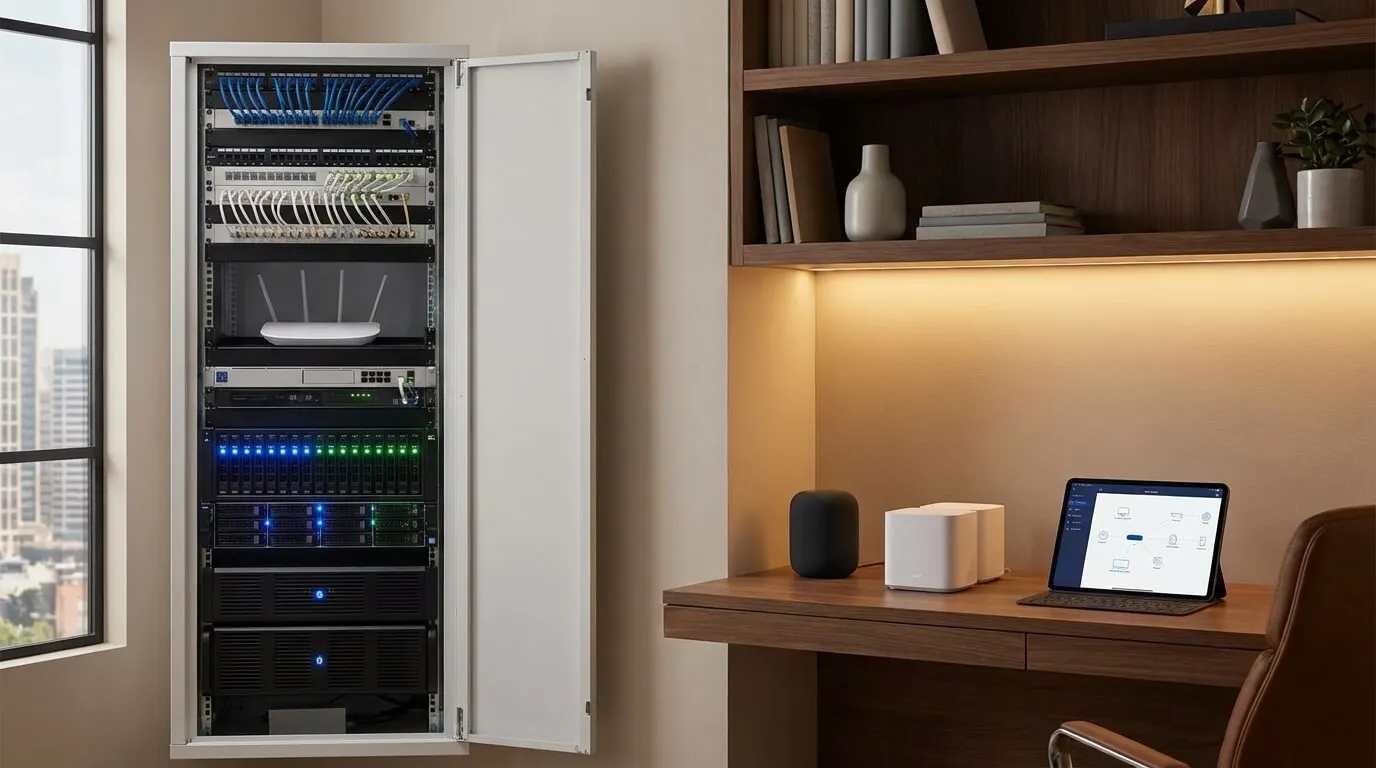
Serena's own hub page is the consumer path: app, remote, and schedules, with voice if you add an assistant. That is not the same thing as a Control4 driver and keypad scenes. Compatible with Alexa is not the same as a whole-home processor already in the rack.
Lutron's Intelligent Hembar Alignment white paper says IHA holds Sivoia QS and Sivoia QED shades within 1/8 inch during motion and at rest. The Serena and Triathlon roller spec lists quiet operation at 38 dBA measured 3 ft from the drive. The Serena Open Roll spec lists 44 dBA at 3 ft. Those are two products. Do not treat 38 dBA as a class rating.
Shades on time of day and sun position belong on the rooms that overheat or wash out a screen. Hunter Douglas says that in summer or warmer climates you can schedule shades to close during the day to keep your house cooler, and that scheduled motion can give a lived-in look while you are away. Lighting keypads that share those scenes are specified on the Lutron lighting page.
Do shades cut cooling costs enough to matter in North Texas?Link to this section
They can cut heat through glass. They are not a new air conditioner. Dallas/Fort Worth's 1991-2020 normals include those 20 days at 100 degrees. West glass in July is the opening that pays first.
A U.S. Department of Energy cellular-shade fact sheet (October 2021) gives two HVAC figures, both for cellular shades, not for every motorized roller. Installing window attachments can save 15% of a household's annual HVAC energy compared with vinyl blinds. Modeled cellular shades saved up to 20% on heating energy and up to 15% on total heating-and-cooling energy versus no shades. The same sheet says the lab work focused on the heating season and that cooling-season control still needed research. That is not a 20-30% cooling-cost promise for a Frisco summer. Use the DOE percentages above when you want an HVAC figure, and use your own June-September bill when you want a dollar estimate. The table below is illustrative math on a summer cooling bill, not a measured savings promise.
| House size | Summer AC allowance (June-Sept) | Illustrative cost with shades | Illustrative annual difference |
|---|---|---|---|
| 2,000-2,500 sq ft | $2,000-$2,800 | $1,600-$2,100 | $400-$700 |
| 2,500-3,500 sq ft | $2,800-$4,000 | $2,100-$3,000 | $700-$1,000 |
| 3,500-5,000 sq ft | $4,000-$5,500 | $3,000-$4,100 | $1,000-$1,400 |
| 5,000-7,000 sq ft | $5,500-$7,500 | $4,100-$5,600 | $1,400-$1,900 |
Per-window savings allowances, by facing:
- West: $50-$100
- South: $40-$80
- East: $30-$60
- North: $20-$40
If the only reason you are motorizing is a utility payback, run the formula on a real bill and a cellular or solar fabric on west and south glass first. If the reason is glare, sleep, or glass you cannot reach, the energy line is a side effect, not the decision.
When is a retail kit or a hand-pull enough?Link to this section
DIY is fine on a reachable Caséta roller or Serena shade when the opening is square, you can follow the bracket template, and you do not need a whole wall to line up. Serena is sold as DIY or pro. The Caséta smart-shade spec lists roller widths up to 96 in (8 feet), in white or gray, light-filtering or blackout.
DIY is a poor plan on two-story glass, on a hardwired low-voltage run, on an arch, or when several shades on one elevation have to stop at the same height. Alignment is what you see from the sofa.
A hand-pull is enough on a small north window you pass every day. Motorizing that opening because the west wall felt good is how a project grows without solving a new problem. Skip motors on glass that stays comfortable and is easy to reach.
If young children are in the house, cordless is the safety reason to change a wand-and-cord shade even when the energy case is weak. The U.S. Consumer Product Safety Commission says the safest option when young children are present is to go cordless. Hunter Douglas makes the same point for smart shades that lack lift cords. Somfy WireFree also states there are no hanging cords on that motor family.
How do you get a written number for your windows?Link to this section
A complimentary phone consultation comes first: which rooms fail, how you want the fabric to behave, and whether a processor is already in the house. If it is a fit, each opening is measured and a written, line-item proposal follows. Nothing in the tables above is that proposal.
A wall of shades that must line up takes more commissioning time than the same number of isolated bedroom windows. A ceiling pocket, if you want the roll hidden, has to exist before the fabric is ordered.
Bring the checklist, a few photos, and the rooms you will phase. Ask for battery versus hardwired on each opening, fabric by job, and control as a separate line so a phone-app scope and a Control4 scope are not blended into one number.
If you want that written number, start on the motorized shades page or contact Digitalholics for a complimentary phone consultation. Digitalholics is a Plano integrator founded in 2015.
SourcesLink to this section
- DOE cellular-shade fact sheet, October 2021: 15% annual HVAC versus vinyl blinds; up to 20% heating and 15% total HVAC versus no shades
- NWS Fort Worth/Dallas 1991-2020 normals: 20 days at 100 degrees; 66.6 F annual mean
- Lutron Serena advantage page: hub, 75 devices, Alexa / Google Assistant / Siri, DIY or pro
- Serena Open Roll spec: 2 year typical battery, five D-cell alkaline, 44 dBA, 24.5-108 in
- Lutron IHA white paper: 1/8 in on Sivoia QS and Sivoia QED
- Serena and Triathlon roller spec: 38 dBA at 3 ft
- Serena / Sivoia QS Triathlon spec: 3-5 year battery life on a 3 ft by 5 ft light-filtering shade moved twice a day
- Sivoia QS Roller 64 spec: standard to 8 ft, WIDR to 12 ft, QS Wired low-voltage
- Caséta smart-shade spec: 22-96 in; white or gray, light-filtering or blackout
- Hunter Douglas PowerView: schedules, app, Pebble remote, Gateway
- Hunter Douglas smart automation: close-for-cooler schedules; no lift cords
- Somfy WireFree: no wiring, recharge once or twice a year, myLink, voice via Alexa / Google Assistant via IFTTT
- CPSC window covering cords: cordless when young children are present
Complimentary phone consultation
Ready to see how it would work in your home?
Start with a complimentary phone consultation. We map the rooms, the scenes you would actually use, and what integrates with what — then a written, line-item proposal before anything is scheduled.
No obligation · We aim to respond within one business day