
The Benefits of Digital Signage for Your Business: Complete 2026 Smart Display Technology Guide
No obligation · We aim to respond within one business day
Complimentary phone consultation
Talk it through with a local designer. Written proposal before anyone books a crew.
No obligation · We aim to respond within one business day
Digital signage is worth it when the message changes often enough that printing is a chore and a named person keeps the screens current. A menu, clinic wait list, or lobby directory can replace reprinting and keep hours and prices accurate the same day. Skip the spend when the copy barely changes or no one will own the updates.
Is digital signage worth it for a restaurant, clinic, shop, or lobby?Link to this section
Guests can read a current message without asking the host, as long as someone keeps the playlist current and the panel stays readable in that light.
For regularly updated public screens, the recommended setup is a commercial display, a player, a CMS (content-management system, the browser login that pushes menus and hours to each player), power, and a network drop. Printed boards may be cheaper when updates are rare. Compare printing and replacement labor with hardware, installation, software, electricity, maintenance, and content labor over the same period. Include equipment you already own and the cost of leaving an outdated offer on display.
| Choose this | When it fits |
|---|---|
| A commercial display, a player, and one CMS | The screen runs through business hours most days, sits where guests look, or needs same-day price and hours changes. |
| A consumer TV and a USB stick | A private office or break room, a few hours a week, one person who will copy a clip by hand. |
| Printed boards | Copy that changes a few times a year, or no one who will log into software. |
| A video wall | You need one image across several panels. That is a different design; start with how to choose a video wall for the space. |
| Skip digital signage | The copy barely changes, or no one will own the playlist. A consumer panel in public view also belongs here unless its manual permits commercial use at those hours and in those conditions. |
A typical scenario: a dining room wants lunch and dinner menus on two menu boards. The manager owns the playlist and changes it twice a day. Plan each board as a commercial panel rated for all-day use, with playback, a CMS login, a wired drop, and an AC outlet. A patio board behind sun-washed glass needs the same duty rating and a brightness check at that location, not a copy of the interior spec. Kitchen audio, patio speakers, and bar zones belong on the restaurant and bar AV page, not on this one.
Complimentary phone consultation
Planning a conference room, AV refresh, or network for your business?
Start with a complimentary phone consultation — scope, timeline and constraints first, then a written, line-item proposal before anything is scheduled.
No obligation · We aim to respond within one business day
Why choose a commercial display over a living-room TV?Link to this section
Compare duty rating (hours the maker rates the panel to stay on), typical brightness in nits (candelas per square meter), orientation, operating temperature, and the commercial warranty terms (confirm those with the supplier for the full model code). The figures below apply to these indoor models. Samsung’s Caribbean specification covers LH55QMCEBGCXGO; LG’s page is global. Before ordering in the US, confirm the full model code and local warranty with the supplier.
| Check | Samsung QM55C (Caribbean-market LH55QMCEBGCXGO) | LG 65UH5N-M |
|---|---|---|
| Rated hours | 24/7 operation | 24/7 operation |
| Brightness (typical) | 500 nit | 500 nits |
| Orientation | Landscape/Portrait | Portrait / Landscape: Yes / Yes |
| Operating temperature | 0°C to 40°C | 0°C to 40°C |
| On-board player and software | Tizen 7.0 operating system | webOS 6.0; compatible with SuperSign CMS, SuperSign Cloud, and SuperSign Control+ |
| Mount pattern | VESA 200 x 200 mm | VESA 300 x 300 mm |
Samsung's home-electronics warranty covers manufacturing defects in normal, noncommercial use under its Standard Limited Warranty. The separate Health and Safety section says the product is intended for residential use only and is not intended for industrial or commercial use. That section also tells owners to contact Samsung service before 24-hour use, high heat, or high humidity. Read the model booklet before you hang a living-room set in a public space.
The LG 65UH5N-M lists a 50,000-hour minimum lifetime. Use the 24/7 duty rating, the 0°C to 40°C range, typical brightness, and the confirmed warranty terms to judge fit.
The QM55C and 65UH5N-M are specified at 500 nit typical. Glare, direct sun, content contrast, and viewing distance still need a check at the proposed wall. If the image has to compete with daylight, shop a high-brightness or outdoor-rated series and confirm that series on its own data sheet.
What player and software keep the screens current?Link to this section
The display shows the content. The player is the computer that feeds it. Some commercial panels include an on-board player. Samsung lists Tizen 7.0 for the QM55C. LG lists webOS 6.0 on the 65UH5N-M and marks SuperSign CMS, SuperSign Cloud, and SuperSign Control+ as compatible. Compatibility is not a bundled licence, subscription, or configured cloud account. Confirm what ships with the panel and what you must buy or activate.
An external player is worth considering when you want one box to drive several screens, a CMS your IT team already uses, or a unit you can swap without taking the panel off the wall. Pick one platform for the whole site. Two CMS logins mean two places to miss an update when a lunch special or closing time changes.
Someone has to maintain the content. Scheduled playback repeats what you already loaded. It does not write tomorrow's menu. Name a person, give that person the login, and write the update schedule: twice a day for menus, weekly for promotions, same day for a sold-out item or a weather close.
A single private office can skip the CMS. Check that the selected television supports USB-loop playback and your file formats. Load the content, set it to repeat, and test whether playback resumes after a power restart. That is a fair DIY job. Public screens that change by daypart, or a manager who is not in the building, are the usual reason to add a CMS and a player that returns to the same playlist after a power blip. There is no fixed screen-count that forces that choice.
What does each screen need for power, network, and mounting?Link to this section
Treat each location as power, a network path, a mount that matches the panel's VESA pattern, and a protrusion that stays legal in the walkway.
Power first. The LG 65UH5N-M draws 130 W typical and 205 W maximum. IEEE 802.3bt Type 4, sold in the trade as PoE++ (Power over Ethernet on four pairs), can deliver up to 90 W at the switch and 71.3 W at the device for Class 8. A Type 4 switch (the power-sourcing equipment) must support at least Class 7 and may support Class 8, so those wattages are Class 8 maxima, not a guarantee on every Type 4 port. Confirm compatible switch, cable, and player, and that the switch has enough power budget. This 65-inch panel's typical draw is above that Class 8 device figure, so plan an AC outlet at the panel. That is an outlet recommendation, not a dedicated-circuit rule. For a compact player, require manufacturer-confirmed PoE+ (IEEE 802.3at) compatibility, or a compatible splitter matched to the player’s voltage and connector. Type 2 Class 4 allows 30 W at the switch and 25.5 W at the powered device. Keep the player’s maximum demand within that device-side allowance, accounting for splitter losses, and confirm the switch and cable budget. Do not assume the screen and the player share one cable.
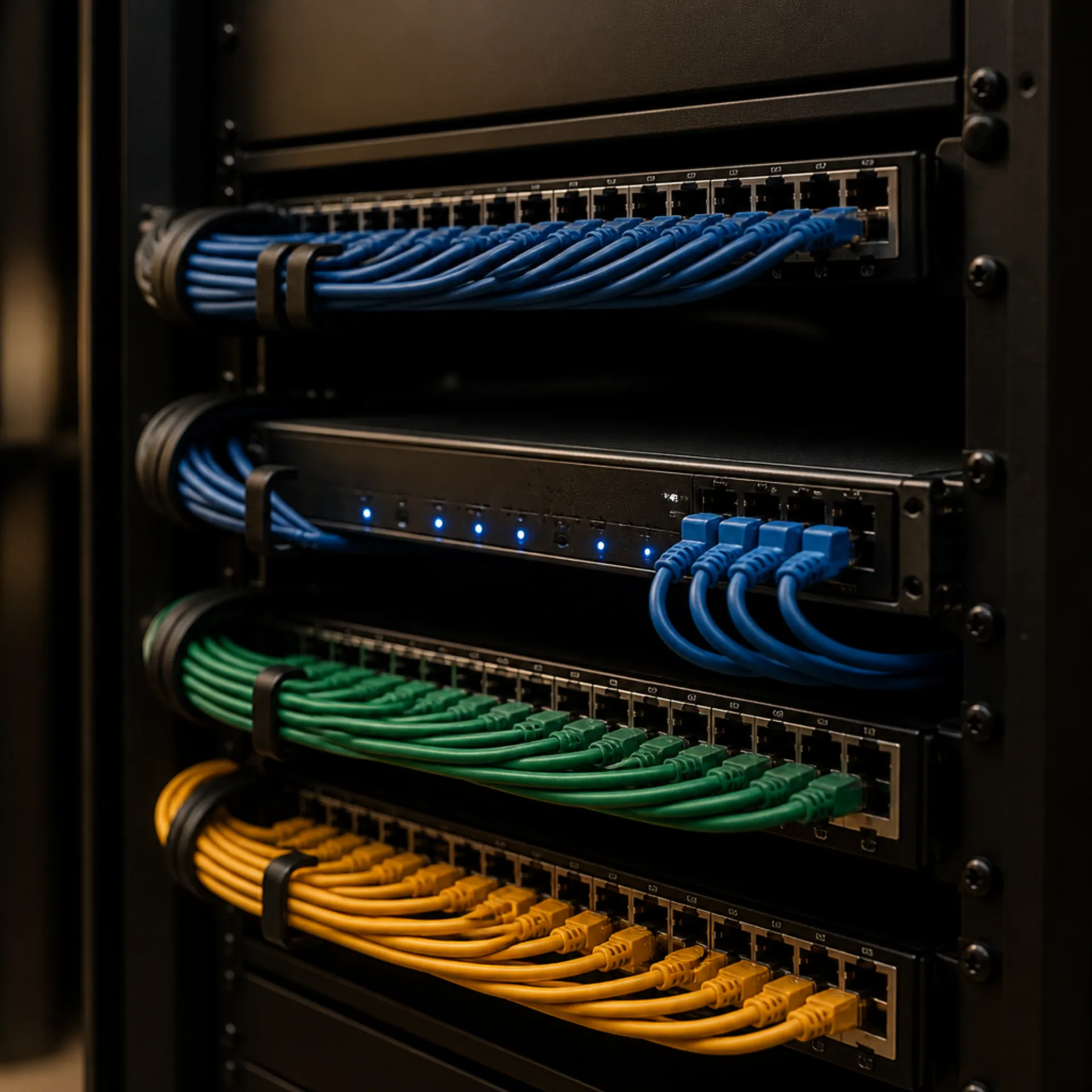
Network next. A wired Ethernet drop is the more reliable choice for a public menu because guest Wi-Fi is shared with visitor phones. Ethernet with four twisted pairs is what 802.3bt uses when you do power a player from the switch. On commercial network jobs we pull Cat6A (thicker Ethernet rated for 10-gigabit) to every access point and desk drop, and land it on a labeled switch. Keep signage off the point-of-sale VLAN (an isolated network segment) if your IT team wants that isolation. The commercial network infrastructure page covers how those drops are surveyed and labeled.
Mounting is a VESA problem, then an ADA problem. The VESA Flat Display Mounting Interface (FDMI) defines mounting interface patterns for flat displays. Hole counts differ by part of the standard, so match the pattern on the data sheet (200 x 200 mm on the QM55C, 300 x 300 mm on the 65UH5N-M) to a mount rated for the panel's weight, and use the screw length the maker lists.
Then check the walkway. Under ADA 307.2, objects with leading edges more than 27 inches (685 mm) and not more than 80 inches (2030 mm) above the finish floor may protrude 4 inches (100 mm) maximum horizontally into the circulation path. The Access Board's guide to protruding objects applies that limit to every circulation path, not only corridors. If the enclosure would stick out farther than that, recess the panel, use a slimmer mount, or add a fixed cane-detectable element whose leading edge is 27 inches high or lower. Objects above that element may project 4 inches from its leading edge, and only if required clear floor space and accessible-route width stay open. Have the installer check the finished arrangement against the full protruding-object rules, not only the 4-inch figure.
Heat and dust sit in the same site survey. Both the QM55C and the 65UH5N-M list a 0°C to 40°C operating range. A closed soffit above a pizza oven, or a west window with no shade, can push the enclosure past that rating. Measure temperature and glare at the proposed location before you order the panel.
How do you tell whether the screens are earning their keep?Link to this section
Compare proposals over the same ownership period, including hardware, installation, software, electricity, content updates, and maintenance. Then test whether the messages help customers act and whether they save staff work.
A typical scenario: a restaurant wants to sell a lunch soup-and-sandwich combination. Show the offer while lunch is available, with its actual price and a clear instruction to order at the counter. Schedule it to stop when lunch ends, and give the shift manager a way to remove it when soup sells out. This can bring an available item to a customer’s attention at the point of purchase; it does not guarantee extra sales.
Before the trial, note item sales, total orders, and gross profit during comparable lunch periods. During the trial, compare the combination’s share of orders and gross profit after ingredient costs and discounts. Keep weekdays and opening hours comparable, and note stockouts, price changes, holidays, and other promotions. More item sales with less profit is not a win. A change during the trial is a signal to investigate, not proof the screen caused it.
For engagement, count a specific action: offer redemptions, scans of a campaign-specific QR link, or requests for the featured service. A scan shows interest; match it to completed orders before calling it revenue. Separately track printing avoided and staff time spent preparing, approving, and correcting content. Continue the trial only if the benefit justifies that work.
- Count reprint trips you no longer make, and the hours the named owner spends updating the playlist. If updates stall, fix ownership and compare the actual running costs with paper before expanding the rollout.
- Walk the floor at lunch and at close. If a sold-out item or a closed hour is still on the board, the content process failed, not the panel.
- Stand where a guest stands. If the intended line is unreadable from glare, size, or contrast, the location or the brightness class is wrong.
A short pop-up can use a borrowed consumer set if the model’s permitted use, warranty, mounting instructions, and operating conditions allow it. Do not buy a 24/7 commercial stack for a screen you will pack away after the event.
What should you finish before you hire an installer?Link to this section
Walk the floor with this list and bring the answers to the first call.
- Write one sentence for each screen: who looks at it, from how far, and what it must say at lunch and at dinner.
- Name the content owner and the update schedule. If that person is "marketing later," you do not have an owner yet.
- Photograph each wall at the brightest hour. Note glass, sun, and whether guests walk within cane range of the mount.
- Confirm an AC outlet and a wired network drop at each location, or budget the electrician and the cable pull. An outlet at the panel is the recommendation for the 205 W maximum on the 65UH5N-M; it does not by itself require a dedicated circuit.
- Measure how far the proposed panel and mount would sit off the wall, and compare that to the 4-inch (100 mm) ADA protrusion limit above 27 inches through 80 inches above the floor. If you need a cane-detectable element, it must be fixed, and clear floor space must remain.
- Pick commercial vs consumer from the table above, including portrait vs landscape and 24/7 vs a residential-use warranty.
- Choose one CMS and one player family for the site, write who holds the admin login, and confirm licences for SuperSign Cloud or SuperSign Control+ before you assume they are included.
- Ask which nights the space can be a job site so guests are not walking under a lift.
Digitalholics LLC, founded in 2015, designs commercial audio-visual systems from our Plano office, including digital signage: a commercial panel, a player, a content manager staff can open in a browser, and a labeled network drop. After a complimentary initial phone consultation, if the project is a fit, we write a line-item proposal. Cost follows screen count, hours of use, cable path, and whether work happens after close. Site visits and design work may carry a fee. If you want that proposal, request a complimentary initial phone consultation or start from commercial audio-visual systems.
SourcesLink to this section
- LG 65UH5N-M UHD signage specifications (500 nits typical, 24/7, 50,000 hours minimum, webOS 6.0, SuperSign CMS / SuperSign Cloud / SuperSign Control+ compatibility, VESA 300 x 300 mm, 130 W typical / 205 W max, 0°C to 40°C)
- Samsung Caribbean QM55C product specifications (QM55C: 500 nit typical, 24/7, Landscape/Portrait, VESA 200 x 200 mm, Tizen 7.0, 0°C to 40°C)
- Samsung home-electronics Standard Limited Warranty and Health and Safety (warranty: noncommercial use; Health and Safety: residential-use and installation warnings)
- ADA Accessibility Standards, section 307.2 Protrusion Limits
- U.S. Access Board guide to protruding objects
- IEEE P802.3bt task force (IEEE Std 802.3bt-2018)
- Ethernet Alliance, Overview of 802.3bt (Type 4 Class 8: up to 90 W at the PSE, 71.3 W at the PD; Type 4 may support Class 8; 802.3at Class 4: 30 W at the PSE, 25.5 W at the PD)
- VESA Flat Display Mounting Interface (FDMI) overview
Complimentary phone consultation
Ready to scope it for your space?
A complimentary phone consultation is the first step: what the room or floor has to do, who uses it, and when it has to be live. Then a written, line-item proposal — no obligation.
No obligation · We aim to respond within one business day