
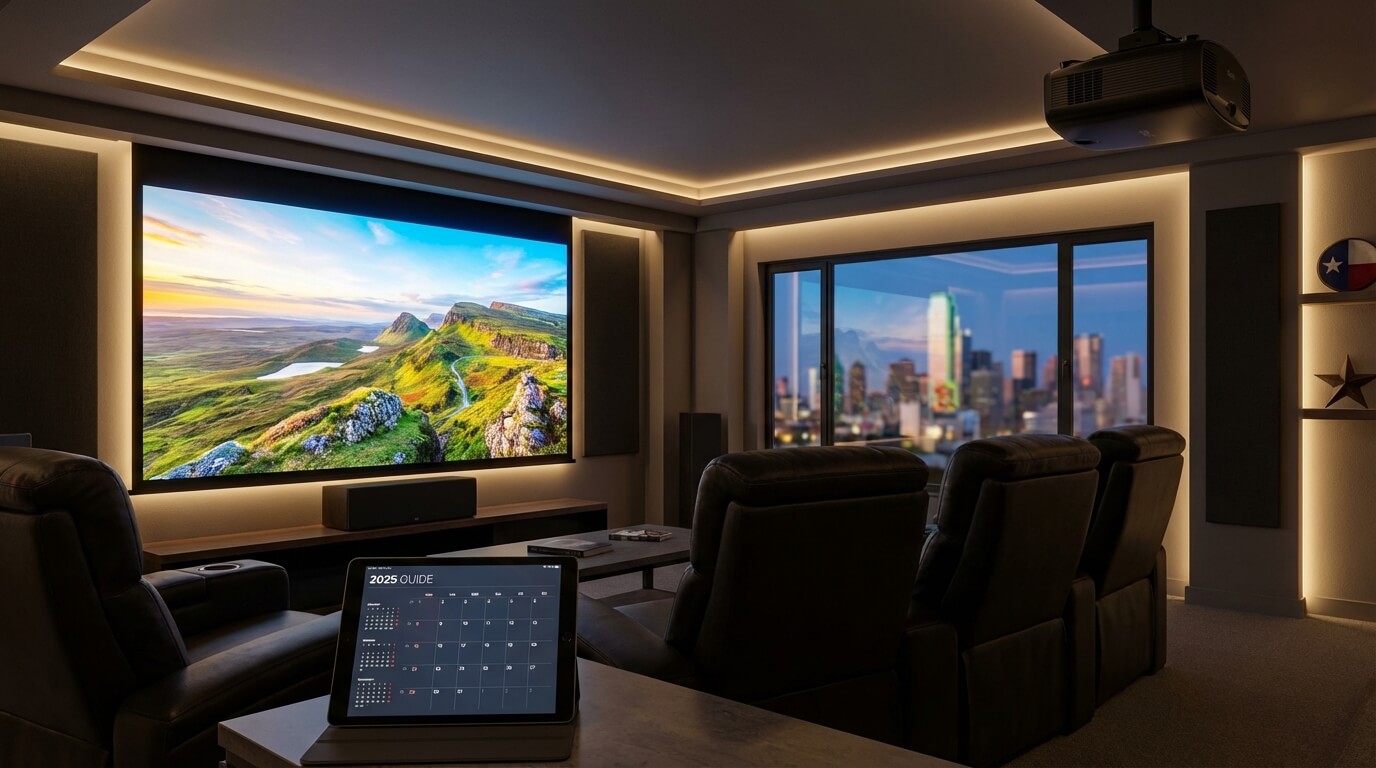
Professional smart home pre-wiring for new construction in Frisco costs $3,000-$8,000 for essential structured wiring to $8,000-$15,000+ for comprehensive automation-ready systems. Pre-wiring during construction saves $10,000-$30,000+ compared to retrofit installation, provides cleaner results, and future-proofs your home for technology that doesn’t exist yet. Critical window: rough-in stage before drywall (typically weeks 4-8 of construction).
This comprehensive guide breaks down exactly what to wire, when to wire it, and how to coordinate with your builder. You’ll learn essential vs optional wiring, understand costs and ROI, discover room-by-room specifications, and avoid expensive mistakes that plague 80% of new construction homes lacking proper infrastructure.
Written by Sri Tummala, Digitalholics Specialist with 9+ years pre-wiring custom homes across Frisco, Plano, and McKinney. Over 300 new construction pre-wire projects completed since 2015, working with major builders including Toll Brothers, David Weekley, and Highland Homes.
Learn more about our new construction pre-wiring and technology consultation services throughout Frisco and North Texas.
Quick Pre-Wiring Cost Summary
| Pre-Wire Package | What’s Included | Cost Range | Retrofit Cost | Savings |
|---|---|---|---|---|
| Essential (Basic) | CAT6 to main rooms, basic AV prep | $3,000-$6,000 | $8,000-$15,000 | $5,000-$9,000 |
| Standard (Recommended) | Complete CAT6, security, automation ready | $6,000-$10,000 | $15,000-$30,000 | $9,000-$20,000 |
| Premium (Future-Proof) | CAT6A, fiber backbone, complete automation | $10,000-$15,000 | $30,000-$50,000+ | $20,000-$35,000 |
| Luxury (Everything) | Complete infrastructure, every room, redundancy | $15,000-$25,000+ | $50,000-$80,000+ | $35,000-$55,000+ |
What’s Included: All wiring materials, installation during rough-in, equipment rack setup, terminations, labeling, and basic testing. Does NOT include endpoints (TVs, speakers, cameras, switches) – just infrastructure.
Critical Timing: Pre-wiring must happen during rough-in phase BEFORE drywall (typically construction weeks 4-8). Missing this window means retrofit pricing – 2-5x more expensive with visible conduit or extensive drywall repair.
ROI Reality: $10,000 pre-wire investment saves $20,000-$40,000 in future retrofit costs. Even if you don’t use all wiring immediately, infrastructure in place for 30+ years. Wiring costs pennies per foot during construction, dollars per foot after drywall.
Why Pre-Wiring Matters: The Retrofit Reality
The Cost of Waiting
| Installation Type | Cost Per Drop | Example (30 Drops) | Result Quality |
|---|---|---|---|
| Pre-Wire (New Construction) | $75-$150 | $2,250-$4,500 | Perfect (hidden in walls) |
| Retrofit (Good Attic Access) | $150-$250 | $4,500-$7,500 | Good (mostly hidden) |
| Retrofit (Limited Access) | $250-$400 | $7,500-$12,000 | Fair (some visible, drywall repair) |
| Retrofit (Slab/No Access) | $400-$600 | $12,000-$18,000 | Poor (surface conduit visible) |
Real-World Retrofit Example (Phillips Creek Ranch Home):
Client bought $850K new construction home in 2020 without pre-wiring. Wanted complete smart home in 2023:
- Needed: 12 security cameras, whole-home audio (8 zones), lighting control (40 loads), motorized shades (25 windows)
- Retrofit cost: $35,000 for wiring alone (cameras $8K, audio $12K, lighting $10K, network $5K)
- Result: Some visible conduit, drywall repairs throughout, 3-week installation disruption
- Pre-wire would have cost: $8,000 during construction with perfect concealment
- Lost savings: $27,000 by not pre-wiring
Why Retrofit Is So Expensive:
- Labor intensive: Fishing wire through closed walls takes 3-5x longer than open-wall installation
- Drywall damage: Often requires cutting holes, patch and paint ($500-$2,000 additional)
- Limited routing: Can’t always reach optimal locations, compromises required
- Living disruption: Working around furniture, family, 2-3 week timeline vs 2-3 days pre-wire
- Visible compromises: Surface-mount conduit, exposed wiring in some areas
What Builders Don’t Tell You
Builder “Standard” Wiring is Inadequate for Smart Homes:
| Feature | Builder Standard | Smart Home Minimum | Premium Smart Home |
|---|---|---|---|
| Living Room | 1 coax, 1 phone jack | 2 CAT6, 2 speaker wire, HDMI conduit | 4 CAT6, 4 speaker wire, fiber ready |
| Master Bedroom | 1 coax, 1 phone | 2 CAT6, 2 speaker wire, TV prep | 4 CAT6, ceiling speakers, shade prep |
| Kitchen | Nothing (just power) | 2 CAT6, speakers, tablet mount | 4 CAT6, distributed audio, keypads |
| Exterior | Nothing | 4-6 CAT6 for cameras | 8-12 CAT6 cameras + gate/doorbell |
| Network Closet | Router on kitchen counter | Dedicated closet, ventilation, outlets | Professional rack, UPS, cooling |
Why Builders Skimp: Wire is cheap ($0.20/ft CAT6), but labor is expensive. Builders minimize pre-wire to keep base price low. They know 80% of buyers won’t notice until move-in, by which point it’s too late.
Builder “Smart Home Package” Warning: Many builders offer “$2,000-$5,000 smart home package” which is inadequate:
- CAT5e instead of CAT6 (outdated standard)
- Minimal drops (1 per room instead of 2-4 needed)
- No camera pre-wire (most critical infrastructure)
- No audio speaker wire
- No automation wiring (keypads, touchscreens, shades)
- Poor equipment closet (inadequate for enterprise networking)
Bottom Line: Insist on hiring third-party technology integrator for proper pre-wire. Builder packages insufficient for modern smart homes.
Learn about our builder coordination services and pre-wire specifications.
Complete Pre-Wiring Specifications by Room
Living Room / Great Room
Essential Pre-Wire:
- TV wall: 2 CAT6 drops, 2.5″ conduit to equipment location for HDMI
- Network: 2 CAT6 drops for WiFi access point (ceiling preferred)
- Audio: 4 in-ceiling speaker wire runs (stereo pair + height channels)
- Lighting control: Low-voltage wire to all switch boxes (neutral wire critical)
Premium Additions:
- In-wall speaker wire (2 front locations)
- CAT6 to media console area (streaming devices, gaming)
- Subwoofer wire or dedicated circuit
- Motorized shade wire (1 wire per window to central location)
- Keypad low-voltage (scene control)
Cost: $800-$2,000 depending on room size and options
Master Bedroom
Essential Pre-Wire:
- TV wall: 2 CAT6, HDMI conduit
- Network: 1-2 CAT6 for access point
- Audio: 2-4 ceiling speaker wires
- Lighting: Low-voltage to switches, neutral wire
- Bedside: Keypad wire (control entire home from bed)
Premium Additions:
- Master closet: CAT6, speakers, occupancy sensor prep
- Master bath: Ceiling speakers, steam control wire
- Motorized shade wire (every window)
- Climate control low-voltage wire
Cost: $600-$1,500
Kitchen
Essential Pre-Wire:
- Network: 2 CAT6 drops (WiFi AP, hardwired devices)
- Audio: 2-4 ceiling speaker wires
- Lighting: Low-voltage to all switches
- Tablet mount: Power + CAT6 (Control4 touchscreen location)
Premium Additions:
- Under-cabinet speaker wire
- Refrigerator CAT6 (smart fridge)
- Multiple keypad locations
- Pantry occupancy sensor wire
Cost: $400-$1,000
Home Theater / Media Room
Essential Pre-Wire:
- Screen wall: 2 CAT6, 2.5″ conduit for projector HDMI
- Projector location: Power circuit, 2 CAT6, HDMI conduit back to rack
- Surround sound: Speaker wire to 7-9 locations (7.1.2 Atmos minimum)
- Subwoofers: 2 locations with dedicated circuits or wire
- Seating: Power + USB at each seat
- Lighting: Complete low-voltage to all switches
Premium Additions:
- In-wall speakers (LCR behind acoustically transparent screen)
- Additional height channels (9.2.4 system)
- Rack ventilation (dedicated AC return)
- Fiber optic from rack to projector (4K 60Hz long-run)
- Acoustic panel mounting blocks
Cost: $2,000-$5,000
Bedrooms (Secondary)
Essential Pre-Wire:
- Each bedroom: 2 CAT6, 2 ceiling speaker wires, TV HDMI conduit
- Lighting: Low-voltage to switches
- Closets: Occupancy sensor prep
Cost per bedroom: $300-$600
Exterior and Garage
Essential Pre-Wire:
- Security cameras: CAT6 to 8-12 locations (all corners, entry points, driveway)
- Doorbell: CAT6 + traditional doorbell wire (video doorbell ready)
- Outdoor audio: Speaker wire to 4-8 patio/pool locations
- Landscape lighting: Low-voltage control wire to transformer location
- Garage: CAT6 for access point, opener integration wire
- Gate system: CAT6 + power to gate location (if applicable)
Premium Additions:
- Pool equipment CAT6 (automation ready)
- Outdoor kitchen: CAT6 + speakers + TV prep
- Additional camera locations (20+ comprehensive coverage)
- Driveway sensors
Cost: $1,500-$4,000
Equipment Closet / Rack Location
Essential Infrastructure:
- Location: Climate-controlled (not garage/attic), central to home
- Power: Dedicated 20A circuit, 8+ outlets
- Ventilation: Return air or fan (equipment generates heat)
- Lighting: LED overhead lighting
- Space: 4’×4′ minimum, 6’×6′ preferred for large systems
- Door: Full-size door (not pocket), ventilation louvers
Wire Terminations:
- All CAT6 runs terminate here on patch panel
- All speaker wires labeled and accessible
- All low-voltage control wires organized
- Space for rack, switches, Control4, NVR, AV equipment
Cost: $500-$1,500 (mostly builder coordination)
Pre-Wiring Packages and Pricing
Essential Package: $4,000-$6,000
Best For: 2,500-3,500 sq ft homes, budget-conscious builders
What’s Included:
- 30-40 CAT6 drops (network, cameras, key locations)
- Security camera pre-wire (8 locations)
- Basic audio (living room, master bedroom)
- TV locations (HDMI conduit to main rooms)
- Equipment closet setup
- All terminations and labeling
What You Can Add Later:
- Whole-home audio (retrofit expensive but possible)
- Motorized shades (retrofit viable)
- Additional cameras (8 covers basics)
Best For: Hollyhock, Richwoods homes planning future upgrades
Standard Package: $6,000-$10,000 (RECOMMENDED)
Best For: 2,500-4,000 sq ft homes wanting comprehensive infrastructure
What’s Included:
- 60-80 CAT6 drops (comprehensive coverage)
- Security cameras (12 locations, complete coverage)
- Whole-home audio wire (6-8 zones)
- All TV locations (HDMI + CAT6)
- Motorized shade low-voltage (all windows)
- Lighting control prep (neutral wire, keypads)
- Professional equipment rack
- Complete terminations, testing, documentation
Future Ready For:
- Complete Control4/Savant automation
- Professional security system
- Whole-home audio
- Motorized window treatments
- Advanced networking
Best For: Phillips Creek Ranch, Newman Village homes wanting automation-ready
Premium Package: $10,000-$15,000
Best For: 4,000-6,000 sq ft homes, luxury smart home plans
What’s Included:
- 100-120 CAT6A drops (10Gbps future-proof)
- Fiber backbone (distribution between floors)
- Security cameras (16-20 locations, estate coverage)
- Premium audio (10-12 zones including outdoor)
- Dedicated theater pre-wire (complete Atmos)
- Every window motorized shade prep
- Multiple keypad/touchscreen locations
- Outdoor audio (pool, patio, landscape)
- Climate zone wiring
- Pool/spa automation prep
- Professional equipment rack with UPS
Best For: Starwood, Frisco Hills custom homes
Critical Timing and Builder Coordination
Construction Timeline for Pre-Wiring
| Construction Phase | Week | Pre-Wire Activity | Critical Actions |
|---|---|---|---|
| Foundation | 1-3 | Planning, equipment closet location | Confirm closet location, power circuits, HVAC return |
| Framing | 4-6 | Equipment closet framing verification | Ensure proper size, door location, power rough-in |
| Rough-In (CRITICAL) | 6-8 | ALL WIRING INSTALLED | Must complete before drywall! This is the window. |
| Drywall | 9-10 | Too late (retrofit pricing now) | Install wall plates, mark locations |
| Finish | 11-16 | Terminate wires, test, document | Patch panel, labeling, testing all drops |
| Move-In | 16-20 | Ready for equipment installation | Install cameras, speakers, Control4, etc. |
The Critical 2-Week Window: Weeks 6-8 when walls are framed but before drywall. Missing this window means retrofit pricing (3-5x more expensive). Builder won’t wait – if you’re not ready, window closes forever.
Builder Coordination Checklist
Before Construction Starts:
- ☐ Hire technology integrator (us!)
- ☐ Review floor plan with integrator
- ☐ Finalize pre-wire plan and pricing
- ☐ Submit pre-wire plan to builder
- ☐ Get builder written approval
- ☐ Confirm equipment closet location and size
- ☐ Add dedicated electrical circuits (network closet, rack, outdoor cameras)
- ☐ Schedule pre-wire timing with builder
During Framing (Week 4-6):
- ☐ Walk-through with builder and integrator
- ☐ Verify equipment closet framing correct
- ☐ Confirm electrical rough-in locations
- ☐ Mark any changes to plan
- ☐ Schedule rough-in installation
During Rough-In (Week 6-8):
- ☐ Integrator installs all wiring (2-3 days)
- ☐ Coordinate with electrician (avoid conflicts)
- ☐ Final walk-through before drywall
- ☐ Photograph all wire locations
- ☐ Label all wires at equipment closet
After Drywall (Week 10+):
- ☐ Install wall plates and trim rings
- ☐ Terminate all wires on patch panels
- ☐ Test all drops (continuity, speed)
- ☐ Provide documentation to homeowner
- ☐ Plan equipment installation post-move-in
Common Builder Pushback and How to Handle
“Our electrician can do the low-voltage.”
- Reality: Electricians wire to code, not smart home best practices. Often use wrong cable type, poor routing, inadequate drops.
- Response: “We’d prefer specialist who does this daily. Will coordinate directly with your electrician.”
“This will delay our schedule.”
- Reality: Pre-wire takes 2-3 days during 2-week rough-in window. Zero impact if planned properly.
- Response: “Our team works during rough-in phase alongside trades. We’ll coordinate to avoid delays.”
“Our standard package covers this.”
- Reality: Builder packages insufficient for modern smart homes (see comparison table above).
- Response: “We’ve reviewed your package and it doesn’t include [cameras, audio, automation wiring]. Can we supplement?”
“You’ll void our warranty.”
- Reality: Low-voltage wiring doesn’t affect structural warranty. This is a stall tactic.
- Response: “We’re fully insured and coordinate with your trades. Low-voltage work doesn’t impact structural warranty.”
Pro Tip: Some builders have “preferred vendor” kickback arrangements. Stand firm on using qualified technology integrator even if builder pushes back. Your $500K-$3M home deserves proper infrastructure.
Frequently Asked Questions
How much does smart home pre-wiring cost for new construction?
Smart home pre-wiring costs $4,000-$10,000 for most new construction homes in Frisco depending on size and complexity. Breakdown: Essential package (2,500-3,500 sq ft, 30-40 CAT6 drops, 8 cameras, basic audio) = $4,000-$6,000. Standard package (3,500-4,500 sq ft, 60-80 drops, 12 cameras, whole-home audio ready) = $6,000-$10,000. Premium (4,500-6,000 sq ft, 100-120 drops, complete automation-ready) = $10,000-$15,000. Retrofit costs 2-5x more: Same standard package costs $15,000-$30,000 after drywall due to fishing labor, drywall repair, and access limitations. Pre-wiring investment saves $10,000-$30,000+ in future retrofit costs while providing superior results with completely hidden infrastructure.
When is the right time to pre-wire during construction?
Pre-wiring must happen during rough-in phase BEFORE drywall, typically construction weeks 6-8. This is a 2-week critical window after framing complete but before drywall installed. Timeline: Weeks 1-3 (foundation) = planning only, weeks 4-6 (framing) = verify equipment closet and power locations, weeks 6-8 (ROUGH-IN) = install ALL wiring, week 9+ (drywall) = TOO LATE for cost-effective pre-wire. Missing this window means retrofit pricing 3-5x more expensive. Coordinate with builder during framing stage (week 4-5) to schedule pre-wire installation for weeks 6-8. Technology integrator needs 2-3 days during rough-in window to install wiring alongside electrician and other trades.
What wiring should I include in pre-wire package?
Essential pre-wire includes: CAT6 Ethernet (2 drops per main room, 4 to living areas, 8-12 for security cameras, 2-4 per bedroom), security camera locations (8-12 minimum covering all entry points and perimeter), whole-home audio speaker wire (2-4 ceiling locations per room for 6-8 zones), TV locations (HDMI conduit + CAT6 to all TV walls), equipment closet (all wiring terminates here with patch panels), outdoor audio (speaker wire to patio/pool 4-6 locations), doorbell (CAT6 for video doorbell). Premium additions: motorized shade low-voltage wire (every window), lighting control prep (neutral wire, keypad locations), climate control wiring, fiber backbone for 10Gbps. Minimum investment $4,000-$6,000, recommended $6,000-$10,000 for future-proof infrastructure.
Can builder’s electrician do the low-voltage pre-wiring?
Electricians can do low-voltage but rarely do it optimally for smart homes. Problems with electrician pre-wire: Use residential-grade CAT5e instead of CAT6 (outdated), insufficient drops (1 per room vs 2-4 needed), no camera pre-wire (not in electrical code), poor wire routing (sharp bends damage cables), inadequate equipment closet (not designed for networking gear), minimal documentation (no testing or labeling). Technology integrators: Use proper CAT6 or CAT6A, strategic drop placement for smart home needs, extensive camera coverage, professional cable management, proper equipment rack setup, complete testing and documentation. Cost difference minimal ($500-$1,500 more for integrator) but result dramatically better. Recommendation: Electrician handles power circuits, technology integrator handles low-voltage for optimal results.
Is pre-wiring worth it if I’m not ready for smart home yet?
Absolutely yes. Pre-wiring is infrastructure investment lasting 30+ years regardless of when you use it. Benefits of pre-wiring now even if not using immediately: Wiring costs $75-$150 per drop during construction vs $250-$600 retrofit (3-5x savings), infrastructure in place when ready (no disruption later), adds home value (future buyers appreciate), future-proof for technology that doesn’t exist yet, no visible compromises (all wiring hidden permanently). Most homeowners use infrastructure in phases: Year 1 – network and security cameras ($5K-$8K), Year 2-3 – whole-home audio ($8K-$15K), Year 3-5 – complete automation ($15K-$35K). Even if you wait 10 years to activate smart home, pre-wire investment saves $15,000-$40,000 in retrofit costs. Wire is cheap now, impossible later.
What is an equipment closet and why do I need one?
Equipment closet is dedicated space housing all smart home technology infrastructure: network switches, WiFi controllers, Control4 processor, audio matrices, security NVR, rack-mounted equipment. Requirements: Climate-controlled location (not garage/attic – equipment overheats), central to home (minimizes wire runs), 4’×4′ minimum (6’×6′ preferred for large systems), dedicated 20A electrical circuit (8+ outlets), ventilation (HVAC return or fan – equipment generates heat), standard door with louvers (not pocket door), all low-voltage wiring terminates here on patch panels. Builder standard: Router on kitchen counter (inadequate). Proper closet: Professional rack, organized patch panels, labeled wiring, UPS backup, room for expansion. Cost: $500-$1,500 during construction (mostly builder coordination). Retrofit: $3,000-$8,000 to create proper closet. Essential for professional smart home – plan this during design phase.
Conclusion: Future-Proof Your Investment
After pre-wiring 300+ custom homes across Frisco since 2015, our message is clear: proper pre-wiring during construction is the single highest-ROI technology decision you’ll make. $6,000-$10,000 invested now saves $20,000-$40,000 in future retrofit costs while providing superior results.
Key Takeaways for Frisco New Construction
Act During Critical Window:
- Rough-in phase (weeks 6-8) is ONLY cost-effective opportunity
- After drywall: retrofit costs 3-5x more with compromises
- Coordinate early (week 1-4 of construction)
- Schedule pre-wire installation weeks 6-8
Invest Appropriately:
- Essential: $4,000-$6,000 (basic coverage)
- Recommended: $6,000-$10,000 (comprehensive future-proof)
- Premium: $10,000-$15,000 (luxury automation-ready)
Coordinate Properly:
- Hire qualified technology integrator (not builder’s electrician)
- Submit plans to builder during design phase
- Stand firm on proper infrastructure
- Don’t accept “builder standard package”
Why Frisco Builders Trust Digitalholics
- 300+ New Construction Pre-Wires Completed
- Relationships with Major Builders (Toll Brothers, David Weekley, Highland Homes)
- Zero Schedule Delays (coordinate seamlessly with trades)
- Complete Documentation (testing, labeling, homeowner handoff)
- Warranty Coordination (fully insured, builder-approved methods)
- Post-Construction Support (equipment installation when ready)
Building in Frisco and need pre-wiring consultation? Schedule a new construction consultation. We’ll review your floor plans, provide detailed pre-wire specifications, coordinate with your builder, and ensure your home is properly infrastructure for modern technology.
Call (469) 666-0747 or email for new construction pre-wire quote. We work with all major Frisco builders.
About the Author
[Author Name], New Construction Technology Specialist
With over nine years pre-wiring custom homes across Frisco, Plano, and North Texas, [Author] specializes in coordinating technology infrastructure with builders to ensure homes are properly prepared for smart home automation.
Credentials:
- CEDIA Certified New Construction Specialist
- 300+ new construction pre-wires completed
- Relationships with 20+ local builders
- Control4, Savant, Crestron certified
About Digitalholics
Digitalholics is Frisco’s premier new construction technology integration firm. We partner with builders and homeowners to ensure proper smart home infrastructure is installed during construction, saving tens of thousands in future retrofit costs.
Learn more about our new construction process →
Related Smart Home Resources
- Smart Home Automation Cost: Equipment and installation pricing
- Network Infrastructure Cost: Professional networking requirements
- Security System Cost: Camera and security pricing
- Smart Home Integration: Our complete services