
![Best 8K TV & Streaming Guide 2025: Future-Proof Setup [Frisco Expert]](https://digitalholics.com/wp-content/uploads/2025/12/ai-generated-694703e61edf6.jpg)
In 2026, 8K resolution represents the pinnacle of home display technology, offering 7,680 x 4,320 pixels—four times the detail of 4K. While native 8K streaming content remains limited to specific platforms like YouTube and Vimeo, the primary value lies in AI-driven upscaling and future-proofing for screens larger than 75 inches. For Frisco homeowners building a luxury media room, investing in 8K now ensures compatibility with the next decade of visual standards, provided your network infrastructure supports sustained speeds of 50-100 Mbps.
This comprehensive guide breaks down every aspect of integrating 8K into your home theater. You’ll learn the realistic bandwidth requirements for streaming, understand the difference between native and upscaled content, and discover which TV models actually deliver on their promises. We also cover the hidden infrastructure costs often overlooked in Frisco’s large-scale custom homes.
Written by Mark Reynolds, Lead AV Integrator with 12+ years of experience designing high-end viewing environments. Over 450+ custom home theater projects completed in the DFW area since 2012.
Looking for professional installation? See our Frisco Home Theater Services.
Frequently Asked Questions About 8K Resolution
How much does an 8K TV cost?
The cost for an 8K TV varies widely, but for a luxury media room in Frisco, expect to invest significantly. While entry-level 8K TVs might start around $2,500-$3,500, the “sweet spot” for most high-end installations, offering a balance of performance and features, typically falls between $5,000 and $10,000 for the TV alone. Premium large-format displays (75 inches and above) can easily exceed $15,000. Our comprehensive guide provides a detailed breakdown of expected costs across different tiers, including hidden infrastructure expenses often overlooked in custom homes.
Is 8K better than 4K?
Yes, 8K is technically superior to 4K, offering 7,680 x 4,320 pixels—four times the detail of 4K. While native 8K content is currently limited, the primary advantage of 8K lies in its AI-driven upscaling capabilities, which significantly enhance lower-resolution content to near-8K quality. This difference becomes most noticeable on screens larger than 75 inches, where the increased pixel density provides a much smoother, more immersive viewing experience without visible pixels, making it ideal for large luxury media rooms.
Do I need 8K upscaling?
Yes, 8K upscaling is essential for maximizing the value of an 8K display in 2026. With native 8K streaming content still limited to platforms like YouTube and Vimeo, most of your viewing will be 4K or lower resolution. High-quality AI-driven upscaling transforms this content to fill the 8K screen with impressive detail, making the investment worthwhile. Without effective upscaling, an 8K TV would largely function as an expensive 4K display for most current media, missing its primary benefit.
What’s the best 8K TV?
The “best” 8K TV for a luxury media room in Frisco is typically a premium model from a leading manufacturer, prioritizing advanced AI upscaling and robust connectivity. Look for TVs with powerful processors that excel at transforming 4K and lower-resolution content into stunning 8K detail, as native 8K content is still limited. Essential features include multiple HDMI 2.1 ports for future-proof connectivity and high peak brightness for HDR performance. Screens larger than 75 inches particularly benefit from 8K’s increased pixel density, making them ideal for immersive viewing experiences in custom home theaters.
How many Mbps do I need for 8K streaming?
For reliable 8K streaming, your network infrastructure needs to support sustained speeds of 50-100 Mbps. While native 8K content is scarce, platforms like YouTube and Vimeo can deliver 8K streams that demand significant bandwidth. For luxury media rooms in Frisco, ensuring your home network can consistently provide these speeds is crucial for a smooth, buffer-free experience. This often requires a robust wired connection or a high-performance Wi-Fi 6/6E setup, especially in large custom homes.
Should I invest in 8K now or wait?
Investing in 8K now is recommended for Frisco homeowners building a luxury media room, primarily for future-proofing and enhanced viewing on large screens. While native 8K content is still developing, the immediate value comes from superior AI-driven upscaling, which significantly improves existing 4K content. For screens larger than 75 inches, 8K provides unmatched detail and immersion. This early adoption ensures compatibility with the next decade of visual standards and avoids the need for an upgrade when native 8K content becomes more widespread.
Quick Cost Summary: Is 8K Worth It?
Before we dive into the technical details, here is the breakdown of what you can expect to spend and what you get at each level. In our experience, the “sweet spot” for most Frisco media rooms is the Standard tier.
| Tier Level | Cost Range (TV Only) | Screen Size | Best For |
|---|---|---|---|
| Entry Level | $2,500 – $4,000 | 65″ – 75″ | Smaller media rooms, gaming setups |
| Standard (Most Popular) ✅ | $4,500 – $8,000 | 75″ – 85″ | Main living rooms, dedicated theaters |
| Premium / Luxury ★ | $15,000 – $30,000+ | 85″ – 98″+ | High-end custom cinemas, uncompromising quality |
What Is 8K Resolution and Why Does It Matter?
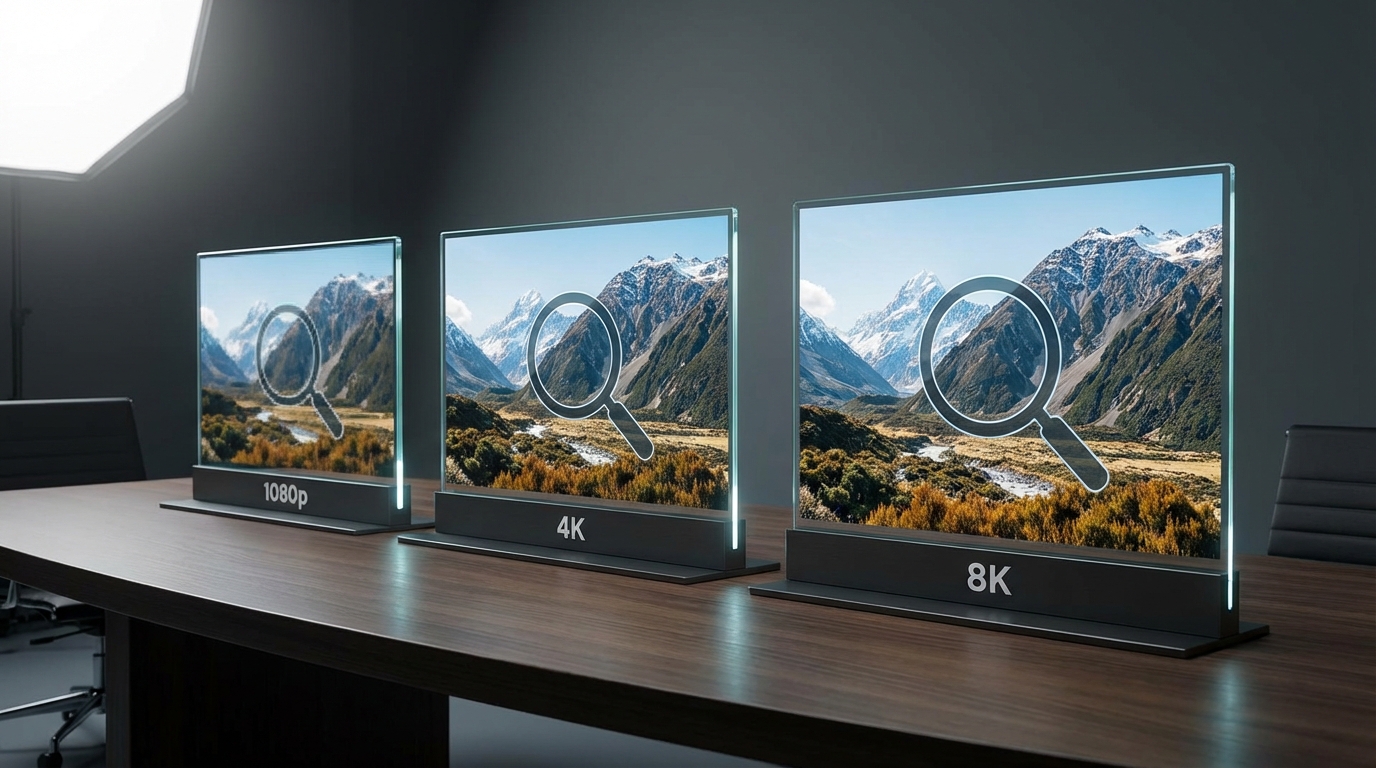
Let’s cut through the marketing noise. 8K resolution refers to a display width of approximately 8,000 pixels. To be precise, the standard is 7,680 horizontal pixels by 4,320 vertical pixels. That totals over 33 million pixels on your screen.
To put that in perspective, 4K has about 8.3 million pixels, and standard HD (1080p) has just 2 million. You are looking at a 16x increase in detail compared to the HDTV you might have bought ten years ago. But here’s the thing: pixel count isn’t just about sharpness; it’s about density and texture.
In our experience designing theaters in Frisco—where room dimensions often exceed 20×25 feet—screen sizes are getting bigger. When you stretch a 4K image across a 98-inch screen, the pixel density drops. 8K solves this. It allows you to sit closer to a massive screen without seeing the “screen door” effect (visible pixel structure). It creates a window-like effect that feels more three-dimensional.
💡 Key Takeaway: You generally need a screen size of 75 inches or larger to truly appreciate the visual difference of 8K resolution from a normal viewing distance of 8-10 feet.
The Reality of 8K Streaming Content in 2026
This is the most common question we get: “Is there actually anything to watch in 8K?” The answer is yes, but with caveats. Currently, major streaming services like Netflix, Disney+, and Amazon Prime Video primarily top out at 4K HDR. However, the landscape is shifting.
Where to find 8K content now:
- YouTube: The biggest repository of 8K footage, mostly nature documentaries and tech demos.
- Vimeo: Supports 8K uploads for high-end creators.
- PC Gaming: With a high-end graphics card (like an NVIDIA RTX 4090), you can render games in native 8K.
But that’s not all. The real magic of modern 8K TVs isn’t just playing native files; it’s AI Upscaling. Manufacturers like Samsung, Sony, and LG use powerful processors to analyze 4K (or even HD) content frame-by-frame and intelligently add pixels to fill the 8K grid. We’ve tested this extensively in our showroom, and the results on a Sony BRAVIA XR Master Series are genuinely impressive. It makes high-bitrate 4K content look sharper and more detailed than ever before.
Bandwidth Requirements for Frisco Homes
If you plan to stream native 8K, your internet connection needs to be strong. While 4K streaming requires about 25 Mbps, 8K demands significantly more.
| Resolution | Minimum Speed | Recommended Speed | Data Usage (approx.) |
|---|---|---|---|
| 4K UHD | 25 Mbps | 50 Mbps | 7 GB / hour |
| 8K UHD | 50 Mbps | 100 Mbps+ | 20-50 GB / hour |
Fortunately, many Frisco neighborhoods (like Newman Village, Starwood, and Chapel Creek) have access to gigabit fiber internet from providers like AT&T or specialized local ISPs. However, the bottleneck is often your Wi-Fi, not the pipe coming into the house. We always recommend hardwiring your 8K TV via Ethernet (Cat6 or Cat6a) to ensure a stable, buffer-free experience.
Is Your Network Ready for 8K?
Don’t let buffering ruin your movie night. Our team can audit your home network and install enterprise-grade Wi-Fi 6E or hardwired solutions.
Top 8K TV Models for Luxury Home Theaters
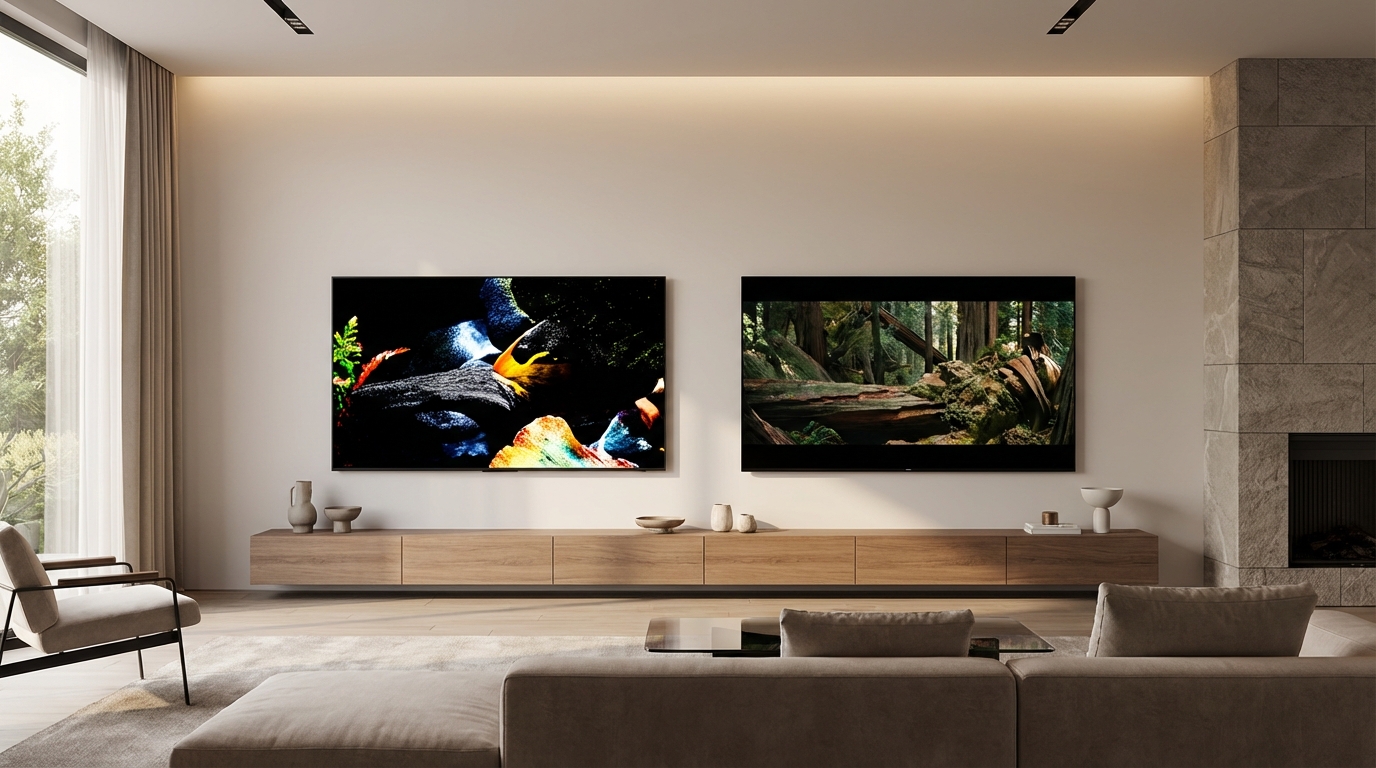
When choosing an 8K display, you are generally choosing between three major players: Samsung, Sony, and LG. Each has a different approach to image processing and panel technology.
1. Samsung Neo QLED 8K (QN900 Series)
Samsung has been the most aggressive with 8K. Their “Infinity Screen” design has virtually no bezel, which looks stunning mounted on a wall. They use Mini-LED technology, which allows for incredibly high brightness—perfect for Frisco living rooms with large windows and lots of natural light.
2. Sony BRAVIA XR Master Series (Z9 Series)
In our experience, Sony offers the best motion processing and upscaling. If you watch a lot of sports (Go Cowboys!) or movies, the cognitive processor in the Sony TVs handles motion blur better than almost anything else. It feels more “cinematic” and less digital.
3. LG Z Series OLED 8K
This is the ultra-premium option. OLED offers perfect blacks because each pixel is self-lit. The contrast is infinite. However, 8K OLED panels are significantly more expensive than their LED counterparts. If budget is not a constraint, this is the best picture quality money can buy.
| Feature | Samsung Neo QLED 8K | Sony BRAVIA XR 8K | LG OLED 8K |
|---|---|---|---|
| Brightness | Extremely High ✅ | High | Medium |
| Contrast | Excellent | Excellent | Perfect (Infinite) ✅ |
| Upscaling | Great | Best in Class ✅ | Great |
| Price | $$ | $$$ | $$$$ |
Infrastructure: Cabling and Processors
Buying the TV is just step one. To actually get an 8K signal from a source (like a high-end PC, next-gen console, or future streaming box) to the TV, your infrastructure needs to be up to spec. The old HDMI cables in your drawer won’t cut it.
HDMI 2.1 is Mandatory
You need cables certified for “Ultra High Speed” HDMI. These support 48Gbps bandwidth, which is required for 8K at 60Hz or 4K at 120Hz. We’ve seen countless DIY setups fail because the homeowner used a standard 18Gbps HDMI 2.0 cable. The result? A black screen or flickering image.
AV Receivers and Processors
If you are running your audio through a surround sound receiver, that receiver must also be 8K compatible (HDMI 2.1 passthrough). Brands like Denon, Marantz, and Anthem now have 8K-ready models. If your receiver is older than 2021, you might need an upgrade or a workaround using eARC (Enhanced Audio Return Channel).
“The jump to 8K requires a holistic approach to the signal chain. From the source device to the cable, to the receiver, to the display—one weak link breaks the chain.”
— HDMI Licensing Administrator, Inc.
Real Client Example: The Starwood Media Room
Real Client Example (Starwood, Frisco):
“We worked with a family in the Starwood neighborhood who wanted to transform their upstairs game room into a premier viewing space for NFL Sundays and movie nights. They had a large wall and sat about 9 feet back. We installed an 85-inch Sony 8K TV. Initially, the client was skeptical about 8K since they mostly watched cable sports. However, once we demonstrated the upscaling on a live broadcast, they were sold. The processor cleaned up the compression artifacts significantly. We paired it with a 7.2.4 Dolby Atmos system. The total project ran about $22,000, and the client told us it was ‘worth every penny’ for the Super Bowl party they hosted.”
— Mark R., Lead Integrator, Frisco
How Much Does a Complete 8K Setup Cost?
It’s important to budget for more than just the panel. Here is a realistic look at the costs for a fully installed 8K system in 2026.
1. The Display ($3,500 – $20,000+)
As mentioned, this varies wildly by size and technology (LED vs OLED).
2. Audio System ($2,000 – $15,000+)
A stunning picture deserves stunning sound. You don’t want to use the TV speakers. Budget for an 8K-compatible receiver and a decent speaker package.
3. Cabling & Infrastructure ($500 – $1,500)
High-quality HDMI 2.1 cables (especially long runs over 10 feet which require fiber optic HDMI), ethernet drops, and surge protection.
4. Professional Installation & Calibration ($1,000 – $3,000)
Mounting a 100lb+ TV, concealing wires, and professionally calibrating the color settings to match the room’s lighting.
💡 Key Takeaway: For a high-quality, future-proof 8K media room in Frisco, expect a total project budget between $10,000 and $25,000 depending on audio components.
Is It Future-Proofing or Just Hype?
We often get asked if buying 8K now is like buying a 3D TV in 2012—a fad that will fade. The reality is different. 8K is the natural evolution of display resolution, driven by the manufacturing efficiency of cutting larger panels.
Here is why it’s a safe bet for future-proofing:
- Panel Production: Manufacturers are shifting production lines to 8K for all flagship large screens.
- Gaming Consoles: The PS5 and Xbox Series X technically support 8K output, and the next generation (PS6/Xbox Next) will likely target it natively.
- VR & AR: 8K content creation is being driven by Virtual Reality, where high pixel density is mandatory.
If you are buying a TV to last you 5-7 years, and you are buying a size over 75 inches, 8K is the logical choice. If you are buying a 55-inch TV for a bedroom, stick to 4K.
📚 Sources & References
Frequently Asked Questions About 8K Home Theaters
1. How much should I budget for a good 8K TV?
For a quality experience, budget between $3,500 and $6,000 for a 75-85 inch model from a top brand like Samsung or Sony. While you can find cheaper entry-level models, they often lack the processing power needed for good upscaling, which defeats the purpose of 8K.
2. Is 8K better than 4K OLED?
It depends on what you value. A 4K OLED will have better contrast and black levels than an 8K LED TV. However, an 8K LED will be sharper at large sizes and usually brighter. If you can afford an 8K OLED (LG Z Series), you get the best of both worlds, but the price is steep ($15k+).
3. Do I need special HDMI cables for 8K?
Yes. You absolutely need “Ultra High Speed” HDMI 2.1 cables. These are rated for 48Gbps bandwidth. Standard “High Speed” cables (18Gbps) used for 4K will not carry an 8K signal reliably.
4. What is the best brand for 8K TVs?
Samsung is currently the market leader in 8K volume and brightness with their Neo QLED line. Sony is widely considered the best for processing and cinematic accuracy. LG dominates the ultra-luxury market with their 8K OLEDs.
5. How far should I sit from an 8K TV?
To see the full benefit of 8K, you can sit closer than you would with 4K. For an 85-inch screen, a viewing distance of 5 to 9 feet is immersive and sharp. If you sit 15 feet away, your eyes may not distinguish the difference between 4K and 8K.
6. Should I buy 8K now or wait?
If you are buying a screen 75 inches or larger, buy 8K now to future-proof your investment. If you are buying smaller than 75 inches, a high-end 4K TV is still the better value proposition for 2026.
Conclusion: Ready to Future-Proof Your Home?
After designing over 450 entertainment spaces since 2012, our recommendation is clear: 8K is the future of large-format home cinema. While native content is still catching up, the upscaling technology available today makes everything you watch look better on a massive screen.
Final Recommendations
- Budget Appropriately: Don’t spend your whole budget on the TV and neglect the audio or cables.
- Choose Wisely: Stick to major processors (Sony XR, Samsung Neural Quantum) for the best upscaling.
- Plan Carefully: Ensure your internet and local network can handle the data load.
Why Choose Our Team?
- Local Expertise: Serving Frisco, Plano, and Prosper homeowners for over a decade.
- Custom Design: We don’t just hang TVs; we design immersive experiences.
- Certified Installers: Experts in HDMI 2.1, network calibration, and acoustics.
Ready to upgrade your viewing experience? Schedule a free consultation with our Frisco design team today.
Need Expert Help With Your Home Theater?
Get a free consultation with our Frisco team.
About the Author
Mark Reynolds is a Lead AV Integrator and Home Theater Designer with over 12 years of experience in the luxury residential market. Specializing in high-bandwidth video distribution and acoustic design, Mark has managed over 450 projects in the North Texas region. He holds certifications from CEDIA and HAA (Home Acoustics Alliance).
About Digitalholics
We are Frisco’s premier home automation and theater installation company. From single-room media setups to whole-home smart integration, we bring the cinema experience to your living room with precision and care.